
The BOLT-3 transducer by AMTI simultaneously measures the applied torque, torque at the threads, and the axial tension in a bolt. It uses strain gages and precision cylindrical elements to isolate and measure forces and torques, enabling a detailed study of bolted element loads. This makes it an essential tool for studying lubricants, pitch size, thread form, material, contact pressure, thread-locking compounds, self-locking inserts, self-locking threads, and the torque and thrust characteristics of lead screws. The BOLT-3 measures the two torques and one force required to analyze fastener stress. It is available in five capacities and two standard housing sizes, with custom units also available. Each model has the sensitivity to accommodate a range of bolt sizes, allowing testing of screws as small as #4 or 3 mm at less than one percent of their rated strength. The BOLT-3 can be attached to a table or machine tool base, clamped in a vise, or integrated into equipment. It can be used with conventional wrenches or mechanical drivers, eliminating the need for a torque wrench as it directly measures applied torque. The unbalanced torques and si
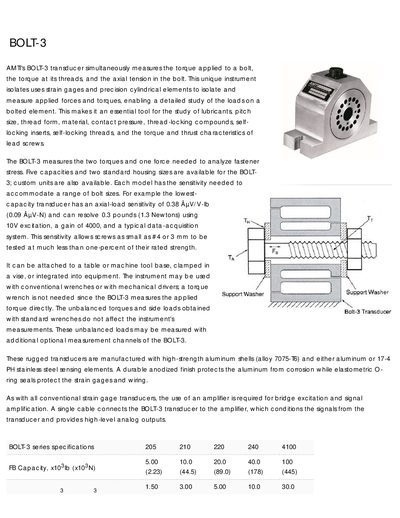
The BOLT-3 is a rugged transducer that simultaneously measures the torque applied to a bolt, the torque at its threads, and the axial tension. It uses strain‑gauge technology and precision cylindrical elements to isolate and quantify applied forces, making it useful for studying fastener stress, lubricants, thread forms, and related characteristics.
Five capacity options and two standard housing sizes are offered, with custom units available. The device features high‑strength aluminum shells (alloy 7075‑T6), optional aluminum or 17‑4 PH stainless‑steel sensing elements, and a typical resonant frequency of 4 kHz. It operates from 0 °F to 125 °F (‑18 °C to 52 °C) and provides bridge outputs with defined resistances and low non‑linearity, hysteresis, and crosstalk.
| Axial‑load sensitivity (lowest capacity) | 0.38 AuV/V‑lb (0.09 AuV‑N) |
|---|---|
| Resolution | 0.3 lb (1.3 N) with 10 V excitation, gain 4000 |
| Housing material | Aluminum alloy 7075‑T6 |
| Sensing element material | Aluminum or 17‑4 PH stainless steel |
| Resonant frequency | 4 kHz (typical) |
| Operating temperature range | 0 °F to 125 °F (‑18 °C to 52 °C) |
| Non‑linearity | < 0.2 % full‑scale output |
It simultaneously measures the torque applied to a bolt, the torque at its threads, and the axial tension in the bolt.
The typical resonant frequency is 4 kHz.
It operates from 0 °F to 125 °F (‑18 °C to 52 °C).