
The HDID-C31 series current sensors are measurement modules that convert the measured DC current into proportionally output DC current or DC voltage using the Hall effect and open-loop measurement principle. They have the characteristics of high accuracy, high linearity, high integration, small size, simple structure, long-term stability, and adaptability to various working environments. They are widely used in the system control and detection of electrical equipment in industries such as power, petroleum, coal mining, chemical, railway, communication, and building automation. They can measure DC current, have strong overload capability, fast response speed, high linearity, disk installation, high insulation between primary and secondary sides, perforated opening design for easy maintenance.
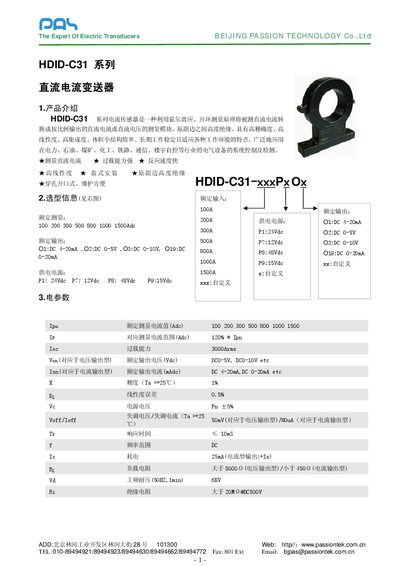
The HDID-C31 series is a Hall‑effect based DC current transmitter offering high linearity, strong overload capability, and fast response. It is designed for use in power, petrochemical, mining, chemical, railway, communications, and building automation applications, with primary and secondary sides fully insulated.
The manual includes product introduction, selection information, detailed electrical parameters, mechanical and wiring diagrams, output characteristic curves, and safety precautions. It also lists operating temperature, storage conditions, dimensions, weight, and compliance standards. This manual is written in Chinese.
| Rated Measurement Current Range | 100 A – 1500 A |
|---|---|
| Output Current (current‑output type) | 4 mA – 20 mA |
| Output Voltage (voltage‑output type) | 0 V – 5 V, 0 V – 10 V |
| Linearity Error | ±0.5 % |
| Response Time | ≈10 ms |
| Power Consumption | 25 mA |
| Load Resistance (voltage output) | > 5000 Ω |
| Insulation Resistance | > 20 MΩ |
| Operating Temperature Range | -25 °C to +70 °C |
| Weight | ≈200 g |
The HDID‑C31 series can measure currents from 100 A up to 1500 A.
The device is rated for operation from –25 °C to +70 °C.
Ensure terminals are not exposed, avoid ESD, only qualified engineers should perform wiring, and verify correct polarity and connections to prevent damage.