
This document contains the features and characteristics of the product_name by the brand in the document.
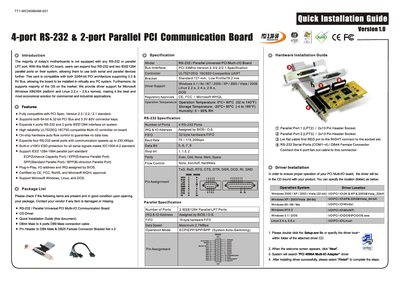
The PCI 4096A Multi‑I/O Adapter expands a standard PC with four RS‑232 serial ports and two IEEE‑1284 parallel ports, supporting both 32‑bit and 64‑bit PCI buses and 3.3 V/5 V connectors. The board works with Windows (3.1 to Vista, 32‑ and 64‑bit), Linux kernels 2.2‑2.6, and DOS, and includes driver CD and a quick‑installation guide.
The manual covers hardware installation, driver installation and removal, COM and LPT port configuration, and troubleshooting. It provides detailed specifications such as supported baud rates, FIFO sizes, and environmental limits, as well as step‑by‑step instructions for setting port parameters in the operating system.
| Number of RS‑232 ports | 4 |
|---|---|
| Number of parallel ports | 2 (IEEE‑1284) |
| Supported baud rate range | 75 bps – 115,200 bps |
| RS‑232 FIFO size | 32 bytes hardware FIFO |
| Parallel FIFO size | 16 bytes hardware FIFO |
| Operating temperature | 0 °C ~ 60 °C |
No. The PCI plug‑and‑play rule and Windows OS limitations prevent remapping the LPT port to legacy ISA addresses.
The board supports 0, 16, or 32 bytes FIFO; the default is 16 bytes. Larger values give higher throughput but may cause overflow on slower CPUs.
Drivers are provided for Microsoft Windows (3.1, 9x, NT, 2000, XP, 2003, Vista, 2008), Linux kernels 2.2‑2.6, and DOS.