
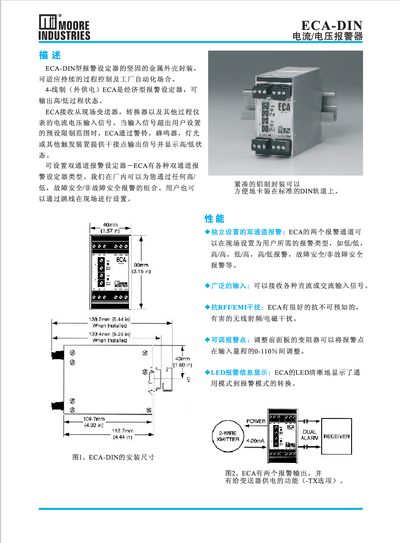
The ECA-DIN is a rugged, metal‑enclosed alarm unit designed for continuous process control and factory automation. It receives current or voltage signals from field transmitters and displays high/low status, while providing dry‑contact outputs such as alarms, buzzers, or lights when limits are exceeded.
The manual covers installation dimensions, wiring, adjustable alarm points, performance specifications, selectable options (e.g., dead‑band adjustment, TX power supply), and detailed configuration tables for dual‑channel alarm types, power supplies, and environmental ratings. This manual is written in Chinese.
| Repeatability | 0.1% of full scale |
|---|---|
| Stability | 0.2% of full scale |
| Alarm dead‑band | 1‑20% of range |
| Response time | ≤0.5 ms |
| Power loss (typical) | 1.53 W |
| Power loss (max with TX) | 3.5 W |
| Operating temperature | -25 °C ~ +70 °C |
| Storage temperature | -40 °C ~ +85 °C |
| Input impedance (current) | 0.002 Ω |
| Input impedance (voltage) | 160 kΩ |
| Input overload (DC current) | 200 % of range |
| Input overload (DC voltage/AC current) | 150 % of range |
| RFI/EMI immunity | 10 V/m |
| Weight | 454 g |
The device normally consumes about 1.53 W, rising to a maximum of 3.5 W when the TX option is used.
It operates from –25 °C up to +70 °C, and can be stored between –40 °C and +85 °C.
The ECA‑DIN can handle a DC current overload up to 200 % of its full‑scale range.
The alarm dead‑band can be adjusted between 1 % and 20 % of the measurement range.