
4HS CiTiceL® (Standard version) Performance Characteristics, including Nominal Range, Maximum Overload, Expected Operating Life, Output Signal Resolution, Temperature Range, Pressure Range, Pressure Coefficient, T90 Response Time, Relative Humidity Range, Typical Baseline Range (pure air), Maximum Zero Shift (+20°C to +40°C), Long Term Output Drift, Recommended Load Resistor, Bias Voltage, Repeatability, Output Linearity.
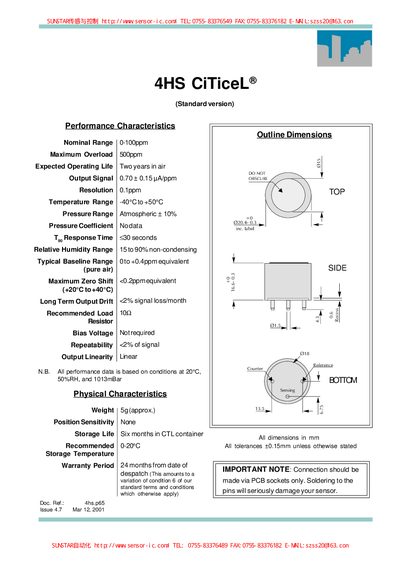
The 4HS Hydrogen Sulphide CiTiceL is a gas sensor designed for detecting hydrogen sulfide in air. It offers a nominal range of 0‑100 ppm, linear output and a two‑year operating life under normal conditions.
The manual lists detailed performance characteristics, physical dimensions, recommended connection methods, cross‑sensitivity to other gases, warranty information and contact details for SUNSTAR Automation. This manual is written in Chinese.
| Expected Operating Life | Two years in air |
|---|---|
| Temperature Range | -40 °C to +50 °C |
| Pressure Range | Atmospheric ±10 % |
| Response Time | < 390 seconds |
| Relative Humidity Range | 15 % to 90 % non‑condensing |
| Recommended Load Resistor | Not required |
| Bias Voltage | < 296 V of signal |
| Repeatability | Linear |
| Output Linearity | Linear |
Connection should be made via PCB sockets only; soldering to the pins will seriously damage the sensor.
The sensor operates from –40 °C to +50 °C.
The expected operating life is two years when used in air.
Cross‑sensitivity is observed for carbon monoxide (300 ppm → <2 ppm), hydrogen (10 000 ppm → <40 ppm), sulphur dioxide (5 ppm → ≈1 ppm), nitrogen dioxide (5 ppm → ≈1 ppm), and nitric oxide (35 ppm → <0.7 ppm).