
ISD1420 is a high-quality single-chip voice recording and playback circuit produced by ISD. It features a convenient single-chip recording and playback system, high-quality reproduction of sound, and zero-power information storage.
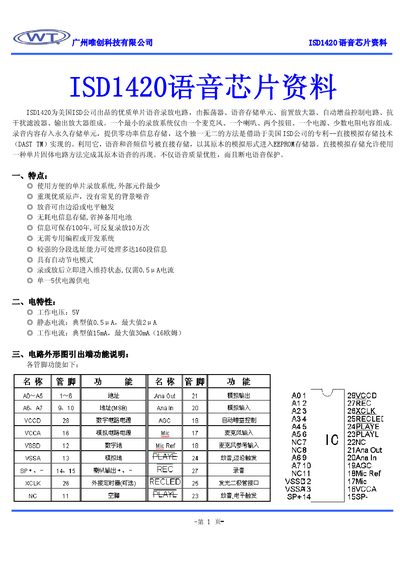
This datasheet describes the ISD1420 voice chip, a single‑chip audio recording and playback solution from the US‑based TSD company. It outlines the minimal external components required for a basic system, the chip’s analog storage method, and its power‑saving features.
Key sections cover electrical characteristics, pin assignments, address‑based operation modes, and example circuit diagrams. The document also lists the chip’s durability, storage capacity, and typical performance parameters. This manual is written in Chinese.
| Working voltage | 5 V |
|---|---|
| Static current (typical) | 0.5 µA |
| Static current (maximum) | 2 µA |
| Operating current (typical) | 15 mA |
| Operating current (maximum) | 30 mA |
| Power supply | Single 5 V supply |
| Maximum stored information duration | 100 years, up to 100 000 playbacks |
| Maximum addressable segments | 160 |
A minimal system needs one microphone, one speaker, two buttons, a power source, and a few resistors and capacitors.
Recorded information can be stored for up to 100 years and replayed up to 100 000 times.
The typical static current is 0.5 µA (maximum 2 µA).
The chip can handle up to 160 addressable segments.