
K 35 • K 50 • K 60 Spring Disc Couplings Protection against shaft currents Every speed and position control is only as accurate as the actual value feedback. The precision of the HÜBNER Digital Tachos (Rotary Encoders) and Analog Tachos (DC Tachos) can only be fully utilized with high-quality, rigid and backlash-free couplings that are optimally matched to their task. In addition to compensating for unavoidable mounting errors - axial displacement - radial displacement - angular displacement, the well-tuned torsional stiffness (torsional spring constant) of the coupling has particular importance in order to prevent the spring-mass system from oscillating in high-dynamic control loops. For this reason, HÜBNER has supplemented the wide range of digital and analog tachos with matching spring disc couplings with clamping hubs. The design principle of the spring disc coupling was chosen because this type of coupling combines the necessary torsional rigidity with a high degree of compensation for axial displacement, which is especially common due to thermal expansion and ball bearing clearance in the drive motor. The clamping hub combines the advantage of a positive connection on a smooth shaft with low space requirements. If necessary, a keyway can also be provided. The two side clamping screws guarantee symmetry when tightening the center and avoid imbalance. The clamping hub on the drive side can be connected to itself or to another shaft to connect multiple tachometers on the shaft.
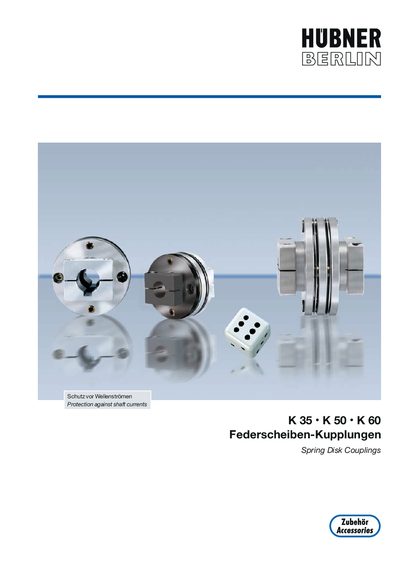
The Hubner K35, K50 and K60 spring disk couplings are designed for precision rotary sensors in drives, control and measurement technology. Their clamping hub provides a friction connection with low space requirement and can be insulated to protect against shaft currents.
The couplings combine high torsional rigidity with compensation for axial, radial and angular displacement, ensuring accurate speed and position feedback for digital and analog tachometers. Technical data follow DIN 740 part 2 and include torque, speed, displacement limits and material details. This manual is written in German.
| Maximum speed (K35) | 15 000 min⁻¹ |
|---|---|
| Torsional rigidity | 900 Nm/rad |
| Moment of inertia | 89‑10 kg·m² |
| Material of spring disks | X12 CrNi 17‑7 |
The technical data correspond to standard DIN 740, part 2.
They are used to couple analog or digital tachometers, or combinations of both, to a drive system.
It offers a friction connection onto a smooth shaft with low space requirement and can be insulated to protect against shaft currents.