
This document is the NARI-RELAYS communication protocol description, which introduces the relevant information of the communication protocol, including the protocol type, communication speed, communication address, etc.
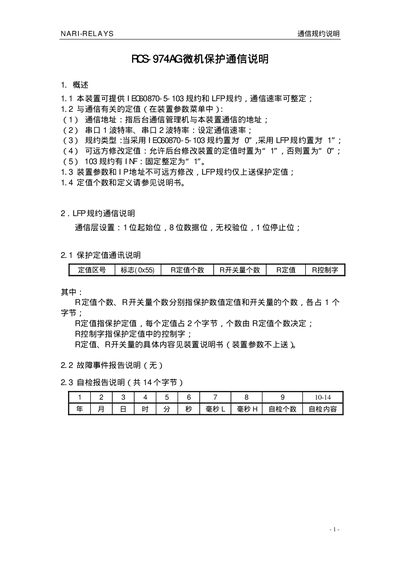
This manual explains the communication protocols supported by the RCS‑974AG protection device, including IEC 60870‑5‑103 and the proprietary LFP protocol. It describes how to configure communication addresses, baud rates for serial ports, and protocol selection.
The document also lists the structure of protection set‑points, fault event reports, self‑test reports, analog measurements, and digital inputs, together with the IEC‑based data group definitions used for transmission. This manual is written in Chinese.
| Supported communication protocols | IEC 60870‑5‑103, LFP |
|---|---|
| Configurable baud rates | User‑settable for serial ports 1 and 2 |
| Communication address setting | Configurable via device parameter menu |
It supports the IEC 60870‑5‑103 protocol and a proprietary LFP protocol.
The address is set in the device parameter menu and cannot be changed remotely.
Yes, the baud rates for serial ports 1 and 2 are configurable.
Fault reports consist of 9 bytes with binary‑coded date‑time fields and a 1‑byte trip‑signal code.