
This Standard specifies the use and application of electric hoists in the events industry. It applies to D8 hoists for the temporary lifting of loads during installation and D8+ hoists with the characteristic of being able to carry loads while stopped above people without the need for a secondary safety device.
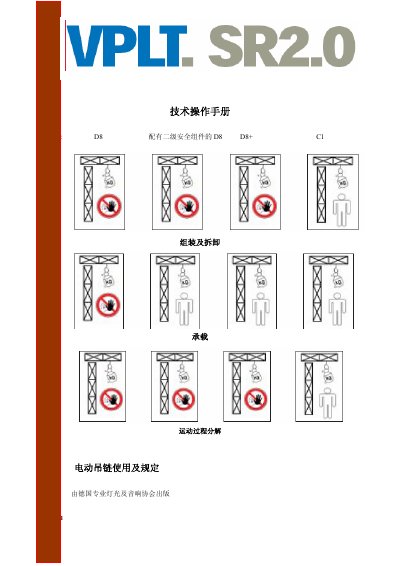
This manual provides the technical operating guidelines for the SR1.0 electric hoist chain system used in live‑event and stage applications. It defines the scope, terminology, selection criteria, assembly, safety equipment, and testing procedures required to meet European and German safety directives.
The document also lists the applicable standards (e.g., DIN EN 60204‑32, EN 954‑1) and includes detailed tables for chain types, load capacities, safety factors, and electrical safety features such as emergency stop switches and overload monitoring. This manual is written in Chinese.
| Secondary safety components | Required for D8+ C1 configuration |
|---|---|
| Emergency stop switch | Required |
| Electrical safety standard | DIN EN 60204‑32 |
The manual ensures that the electric hoist chain is used and regulated at a uniform safety level, covering identification, technical documentation, application, testing standards and occupational safety requirements.
Mandatory features include rotation and phase monitoring, emergency stop switches, electric shock protection, over‑current protection, automatic restart prevention after fault, environmental protection, and travel‑direction selection.