
This manual provides an overview of the Pololu Maestro Servo Controller. It covers topics such as the product overview, hardware interface, connection methods, driver installation, and usage instructions.
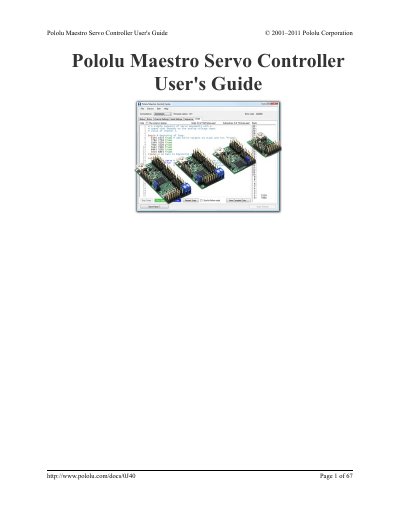
The Pololu Maestro family are second‑generation USB servo controllers that support three control methods—USB, TTL serial, and internal scripting—and offer configurable channels that can act as servo outputs, digital I/O, or analog inputs. The controllers are compact, low‑jitter, and can be daisy‑chained for larger systems.
This manual explains how to install Windows and Linux drivers, use the Maestro Control Center, connect the device via USB or TTL serial, write scripts, and wire servos and peripherals. It also includes detailed specifications for the Micro Maestro and Mini Maestro (12, 18, 24‑channel) models, as well as wiring examples and software development guidance.
| Channels | 6, 12, 18, 24 |
|---|---|
| Analog input channels | 6, 12, 12, 12 |
| Digital input channels | 0, 0, 6, 12 |
| Board width | 0.85" (2.16 cm) – 1.10" (2.79 cm) |
| Board length | 1.20" (3.05 cm) – 2.30" (5.84 cm) |
| Weight (without header pins) | 3.0 g – 6.0 g |
| Configurable pulse rate | 33–100 Hz (Micro) / 1–333 Hz (Mini) |
| Pulse range | 64–3280 µs (Micro) / 64–4080 µs (Mini) |
| Script memory size | 1 KB (Micro) – 8 KB (Mini) |
The board can be powered from USB or from a 5 V to 16 V external battery.
The Micro Maestro provides 6 configurable channels.
TTL serial supports 300 – 200 000 bps in fixed‑baud mode and 300 – 115 200 bps in auto‑detect mode.