
Relays are automatic switching devices with isolation function, widely used in remote control, telemetry, communication, automatic control, mechatronics and power electronic equipment, and are one of the most important control components. Relays have various functions such as expanding control range, amplifying, synthesizing signals, automatic control, remote control, and monitoring.
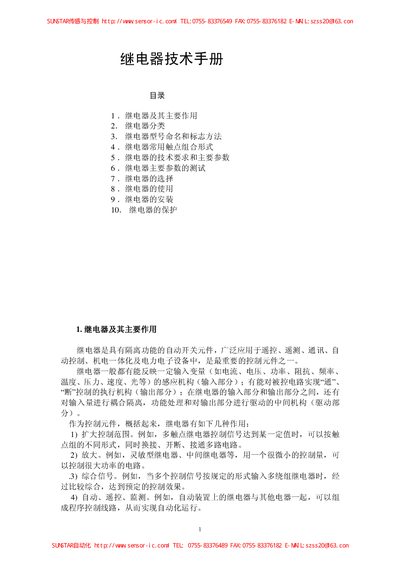
The document provides a comprehensive overview of relays, describing their isolation function, common applications, and the various types such as electromagnetic, solid‑state, and hybrid relays. It also details how relays expand control range, amplify signals, and enable automatic and remote control.
It further covers technical requirements, including mechanical and electrical parameters, testing methods, selection criteria based on environment and load, installation guidelines, and protection measures for contacts and coils. This manual is written in Chinese.
| Micro‑power relay contact rating | 0.1 A at 27 V DC |
|---|---|
| Coil resistance temperature coefficient | α = 0.004 / °C |
| Release voltage (typical) | ≈30 % of rated voltage |
| Maximum coil voltage for DC relays | 75 % of rated voltage |
The release voltage is usually about 30 % of the rated voltage.
Use a parallel diode or an RC snubber network to suppress the back‑EMF and protect the contacts.
The coil voltage should not exceed 75 % of the relay’s rated voltage.
A micro‑power relay can handle up to 0.1 A (or 0.2 A) at 27 V DC for resistive loads.