
ZCS series ultrasonic level transmitter is a non-contact liquid level measurement product produced by Beijing Zhenggong Electronic Technology Co., Ltd. This product uses German imported sensors and advanced microprocessing technology, and has excellent stability, high and low temperature resistance, and corrosion resistance. It is widely used in industries such as tap water, sewage, petroleum, chemical, metallurgy, papermaking, power, open channel flow measurement, food, and beverage.
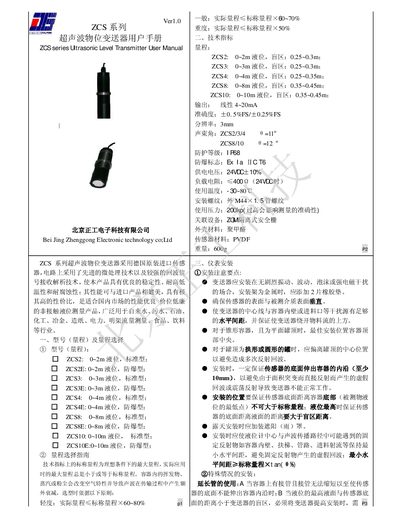
This manual describes the ZCS series ultrasonic level transmitters produced by Zhenggong. It covers the technical specifications for each model (ZCS2, ZCS3, ZCS4, ZCS8, ZCS10), including measurement ranges, output signals, power requirements, and environmental limits. Installation instructions detail proper mounting, use of extension or wave‑guide tubes, and wiring of the 2 m four‑core cable.
Additional sections explain how to set zero‑point correction for installations where the sensor height is less than the rated range, provide troubleshooting steps for common issues such as no signal or unstable output, and outline warranty terms and contact information for service. This manual is written in Chinese.
| Measurement range (ZCS2) | 0–2 m |
|---|---|
| Measurement range (ZCS3) | 0–3 m |
| Measurement range (ZCS4) | 0–4 m |
| Measurement range (ZCS8) | 0–8 m |
| Measurement range (ZCS10) | 0–10 m |
| Output signal | 4–20 mA linear |
| Accuracy | ±0.25 %FS |
| Supply voltage | 24 VDC |
| Explosion protection | Zone 1a IEC T6 |
| Housing material | POM (聚甲醛) |
| Sensor material | PVDF |
| Weight | 600 g |
| Mounting thread | M44×1.5 |
Verify that the power supply is correct and the wiring follows the red‑black‑white convention (24 V + , 24 V – , 4‑20 mA signal). If power and wiring are OK, the unit may be damaged and should be returned for repair.
Ensure the sensor face is perpendicular to the liquid surface, remove any water droplets from the probe, and provide adequate ventilation around the probe to avoid condensation or airflow disturbances.