
This document introduces the features and characteristics of model 8004 and 8008 special clamp meters, which can measure large diameter conductors and large currents.
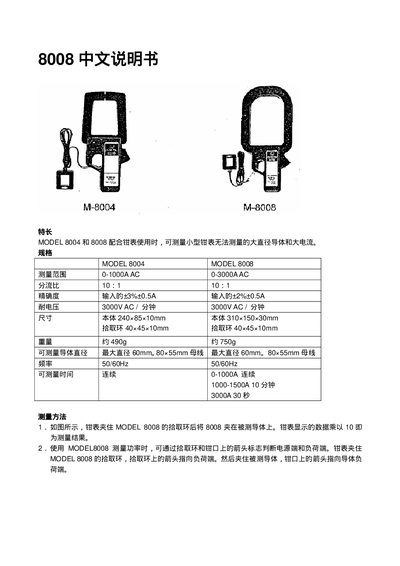
This manual describes the technical specifications of the Kew 8004 and 8008 clamp meters, including current measurement ranges of 0‑1000 A AC (8004) and 0‑3000 A AC (8008), a 10 : 1 shunt ratio, 3000 V AC voltage rating, and dimensions of 240×85×10 mm (8004) and 310×150×30 mm (8008). It also lists the pickup size (40×45×10 mm), weight (≈ 490 g for 8004, ≈ 750 g for 8008), and a maximum conductor diameter of 60 mm.
The measurement method explains how to place the pickup on the conductor, multiply the displayed value by 10 to obtain the actual current, and, for power measurements with the 8008, connect the pickup to both the source and load ends as shown in the diagrams. Safety notes and contact information for Kew Ltd. are also provided. This manual is written in Chinese.
| Current measurement range (8004) | 0‑1000 A AC |
|---|---|
| Shunt ratio | 10 : 1 |
| Voltage rating | 3000 V AC |
| Dimensions (8004) | 240 × 85 × 10 mm |
| Dimensions (8008) | 310 × 150 × 30 mm |
| Pickup size | 40 × 45 × 10 mm |
| Weight (8004) | ≈ 490 g |
| Maximum conductor diameter | 60 mm |
| Frequency | 50/60 Hz |
The 8004 model measures AC current from 0 to 1000 A.
Both models can measure conductors up to 60 mm in diameter.
Place the pickup on the conductor, connect the pickup leads to the source and load ends as shown, then read the displayed value and multiply by 10 to obtain the actual power.