
PGU410 power regulator regulates the output voltage by controlling the conduction phase according to the input signal of 4~20mA or manual controller (QN740A101).
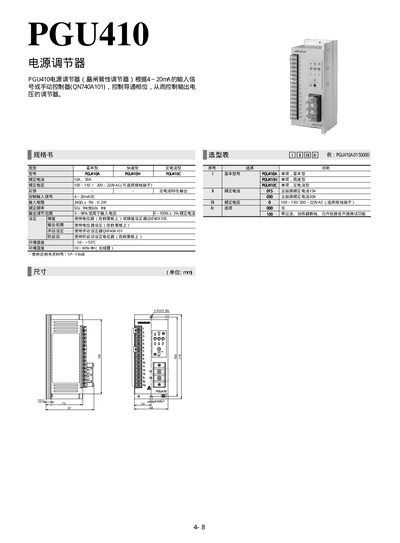
The PGU410 is a thyristor‑type power supply regulator that controls output voltage by adjusting the conduction phase based on a 4‑20 mA input signal or a manual controller (QN740A‑101). It supports both basic, fast, and constant‑current modes, with selectable input terminals for 100‑110 V or 200‑220 VAC.
The device offers adjustable output range (0‑100 % of input voltage), over‑current protection, heater break detection, and component short/open testing. Settings can be made via front‑panel potentiometers, gradient setters, or manual controllers. It operates in ambient temperatures from –10 °C to +55 °C with humidity up to 96 % non‑condensing. This manual is written in Chinese.
| Rated Current | 15 A, 30 A |
|---|---|
| Rated Voltage | 100‑110 V / 200‑220 VAC |
| Control Input Signal | 4‑20 mA DC |
| Input Resistance | 2400 Ω |
| Rated Frequency | 50 Hz or 60 Hz |
| Output Adjustment Range | 0‑100 % of input voltage |
| Operating Temperature | -10 °C to +55 °C |
It accepts a 4‑20 mA DC control signal.
The output can be set with a front‑panel potentiometer, a gradient setter (QN740A‑105), or a manual controller (QN740A‑101).
It can be configured for 100‑110 V or 200‑220 VAC input.
It operates from –10 °C to +55 °C with humidity up to 96 % non‑condensing.