
This document introduces the features and usage of HOTEC HTC-203U portable microcomputer resistance/temperature meter. The instrument has multiple functions and measurement ranges, and is easy to use. It is suitable for measuring the resistivity and temperature of different liquids.
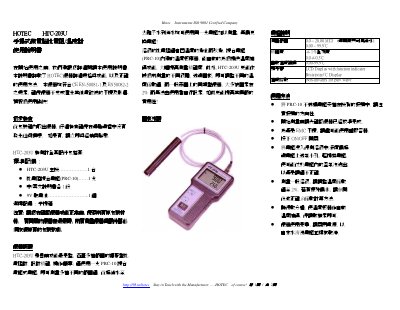
The HTC-203U is a handheld microcomputer resistivity/temperature meter that measures resistivity from 0.0 to 20.00 MΩ and temperature from 0.00 to 99.9 °C. It features automatic temperature compensation, a single PRC‑10 composite electrode usable from ultrapure water to seawater, and adjustable temperature‑coefficient settings via the front panel.
Before measuring, verify the instrument is calibrated, insert the PRC‑10 electrode, turn the power on, and follow the step‑by‑step procedure: avoid EMC interference, immerse the electrode, stir gently to release bubbles, allow the sensor to stabilize, and read the value. After each measurement, rinse the electrode with tap water, dry it, and perform a recalibration if needed. The manual also outlines warranty terms and safety precautions. This manual is written in Chinese.
| Resistivity measurement range | 0.0 – 20.00 MΩ |
|---|---|
| Temperature measurement range | 0.00 – 99.9 °C |
| Accuracy | +/- 1% full scale |
| Automatic temperature compensation | Enabled |
| Display | LCD with function indicator |
Use the panel to set the temperature‑coefficient value; for general solutions set it to 2 % and adjust as needed for special requirements.
After each measurement, rinse the probe with clean tap water, wipe it dry, and then recalibrate the instrument if necessary.