
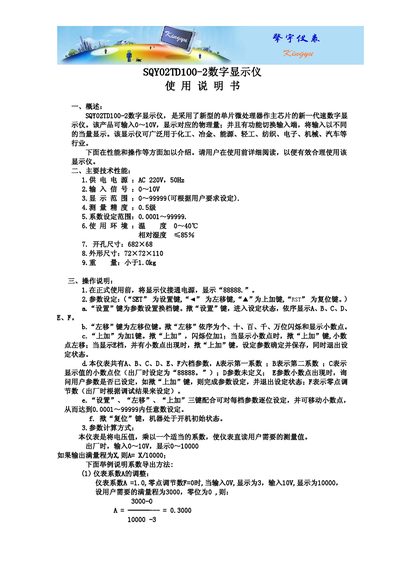
SQY02TD100-2 digital display instrument user manual, introduces the product's power supply, input signal, display range, measurement accuracy, coefficient setting range, use environment, hole size, appearance size, weight and other major technical performance, as well as parameter setting, operation instructions, parameter calculation method, example of coefficient and parameter setting.
The SQY02TD100-2 digital display instrument is a next‑generation device that uses a micro‑processor to convert a 0‑10 V input into a readable physical value. It is suitable for a wide range of industrial sectors such as chemical, metallurgy, energy, textiles, electronics, machinery and automotive.
The manual describes the main technical performance, step‑by‑step operation, parameter configuration (coefficients, decimal points, zero‑adjustment), calculation methods, wiring connections, and the complete kit contents. Users are instructed to read the guide before first use to ensure correct setup and reliable measurement. This manual is written in Chinese.
| Power supply | AC 220 V, 50 Hz |
|---|---|
| Input signal | 0–10 V |
| Display range | 0–99999 (configurable) |
| Measurement accuracy | 0.5 grade |
| Coefficient setting range | 0.0001–99999 |
| Operating environment | Temperature 0–40 °C, Humidity ≤85 % |
| Opening size | 682 × 68 mm |
| Dimensions | 72 × 72 × 110 mm |
| Weight | < 1.0 kg |
Press the RST (reset) key; the device returns to the power‑on initial condition.
Connect S1/0V to the 0–10 V input, terminals 1 and 2 to 220 V AC, and follow the listed terminal assignments for switching and power supply.