
The SB-EN3 is a tin dioxide semiconductor gas sensor which was specially developed for mouth odour level monitoring. This sensor has a high sensitivity to sulphur compounds and hydrocarbons which can be produced in the mouth depending on the conditions of mouth and/or human body.
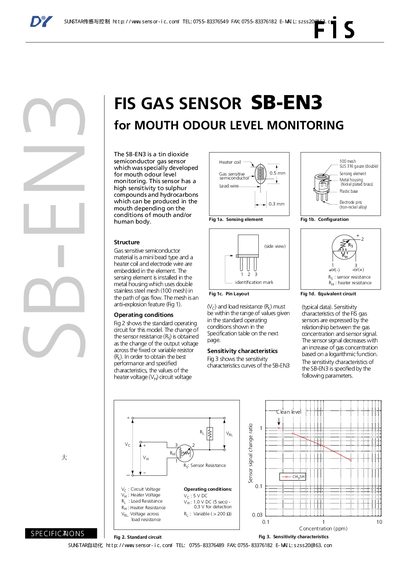
The SB-EN3 is a tin‑dioxide semiconductor gas sensor developed for mouth odour level monitoring. It features a mini‑ped type sensing element, heater coil, and electrode wire embedded in a metal housing with double stainless‑steel mesh for anti‑explosion protection.
The document provides standard operating conditions, sensitivity curves, mechanical characteristics, and a parts list. Key specifications include heater voltage, circuit voltage, load resistance, temperature range, and humidity limits, along with recommended pre‑heating time and vibration tolerances. This manual is written in Chinese.
| Heater voltage (VH) | 0.3 V – 2.0 V |
|---|---|
| Circuit voltage (Vc) | < 5 V |
| Load resistance (RL) | Variable > 200 Ω, ≤ 10 mW |
| Heater resistance (RH) | 2.8 Ω ± 0.2 Ω at room temperature |
| Heater current | 140 mA max |
| Power consumption (PH) | 140 mW max |
| Operating temperature | -0 °C to 40 °C |
| Storage temperature | -105 °C to 70 °C |
| Relative humidity (RH) | < 95 % |
| Frequency | 100 cpm |
| Vibration amplitude | 4 mm vertical |
| Acceleration | 100 G |
| Pre‑heating time | > 48 hours |
It is a tin‑dioxide semiconductor gas sensor specially developed for mouth odour level monitoring.
The sensor has high sensitivity to sulphur compounds and hydrocarbons.
A pre‑heating time of more than 48 hours is recommended.