
The SMF series wind pressure transmitter produced by Shanghai Keqi Automation Instrument Co., Ltd. has high sensitivity, high accuracy, and strong overload capacity. It adopts imported sensors to manufacture and highly integrates sensors and amplifiers; adopts pressure die-cast aluminum surface spray paint shell, and the circuit zero point and gain do not need to be adjusted; has strong anti-interference ability, acid and alkali resistance, and long-term stability and reliability.
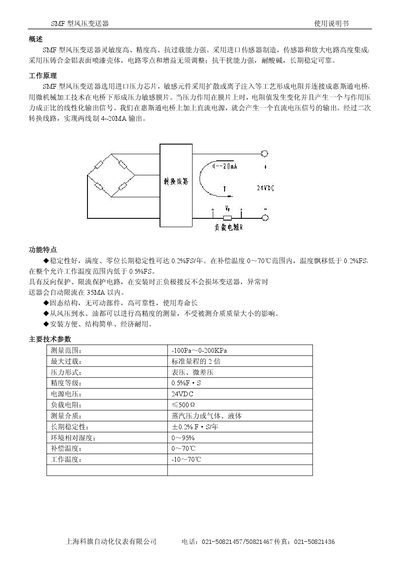
The SMF/WMF wind pressure transmitters feature high sensitivity, high accuracy and strong overload resistance. They use an imported pressure chip and a highly integrated sensor and amplification circuit, housed in a die‑cast aluminum body with a painted surface. The sensor element forms a Wheatstone bridge whose resistance changes proportionally with applied pressure, producing a linear 4‑20 mA output.
The manual describes the device structure, adjustment method (zero‑point and span calibration using a standard power source and ammeter), and safety precautions such as avoiding direct mechanical stress on the membrane, proper torque on connections, and overload limits. Technical parameters such as measurement range, accuracy, supply voltage and environmental limits are also listed. This manual is written in Chinese.
| Measurement range | -100 Pa to 200 kPa |
|---|---|
| Maximum overload | 2 × full scale |
| Pressure type | Gauge pressure, differential pressure |
| Accuracy class | 0.5 % FS |
| Supply voltage | 24 V DC |
| Load resistance | ≤ 500 Ω |
| Measured medium | Steam pressure or gas, liquid |
| Long‑term stability | ±0.2 % FS / year |
| Operating temperature | -10 °C to 70 °C |
| Compensation temperature range | 0 °C to 70 °C |
| Relative humidity | 0 % to 95 % |
| Output current | 4 – 20 mA |
First, with the transmitter unpressurized, adjust the zero‑point resistor until the output current is 4 mA. Then apply full‑scale pressure and adjust the span resistor until the output reaches 20 mA. Repeat the steps two or three times until the signal is stable, and finally tighten the protection cover.