
The MC145012 is a low-power BICMOS smoke alarm circuit that includes an extremely low-power analog-digital circuit. It is used simultaneously with an infrared photoelectric cavity to detect smoke by receiving light scattered by tiny smoke particles. When smoke is detected, the push-pull output circuit in the circuit drives the external buzzer to sound an alarm.
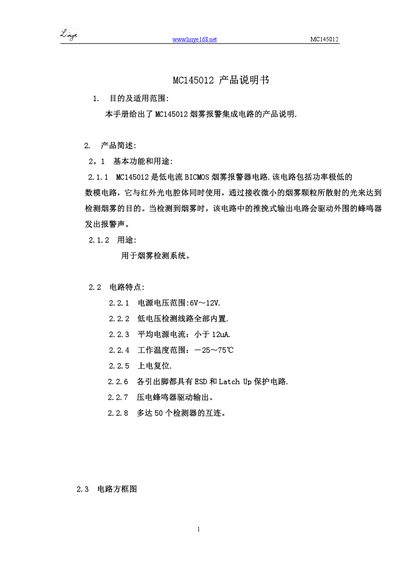
This document describes the MC145012 low‑current BICMOS detector, covering its purpose, basic functions, and typical applications. It includes detailed pin‑function tables, functional block diagrams, and timing diagrams to aid designers in integrating the device.
Electrical specifications such as supply voltage range, input current, and temperature limits are listed, along with calibration mode operation and typical usage notes. The information is presented in both Chinese and English terminology for reference. This manual is written in Chinese.
| Supply voltage (Vp) | -0.5 to 15 V |
|---|---|
| Sense voltage (Vs) | -0.3 to Vp+0.3 V |
| Input current (Iin) | 10 mA |
| Operating temperature | -25 °C to +75 °C |
| Storage temperature | -55 °C to +125 °C |
| Typical standby current | 12 µA |
The device operates with a supply voltage (Vp) from –0.5 V up to 15 V.
It can operate from –25 °C to +75 °C.
The typical input current is 10 mA.