
5MF CiTiceL® is a gas sensor for measuring gas concentration. Its nominal range is 0-40,000ppm, maximum overload is 0-100,000ppm. The replaceable filter unit can extend the service life. The output signal resolution is 0.010 ± 0.004 µA/ppm, the temperature range is -20°C to +50°C.
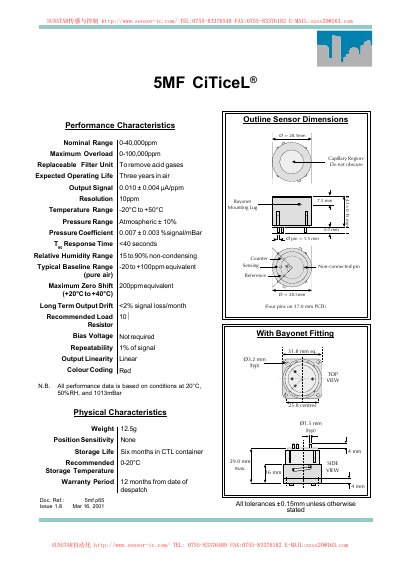
This datasheet details the 5MF CiTiceL sensor series, covering nominal detection ranges, overload limits, output signal resolution, temperature and pressure ranges, response times, and expected operating life. It also includes physical dimensions, storage recommendations, and warranty information.
Cross‑sensitivity data are presented for common interfering gases, and extensive tables list model variants for different target gases such as CO, H₂S, NH₃, O₂, NO₂, and many others, along with their respective lifetimes and measurement ranges. This manual is written in Chinese.
| Nominal Range | 0‑40,000 ppm |
|---|---|
| Maximum Overload | 0‑100,000 ppm |
| Output Signal Resolution | 0.010 ± 0.004 µA/ppm |
| Temperature Range | -20 °C to +50 °C |
| Pressure Range | Atmospheric ± 10 % |
| Response Time | < 40 seconds |
| Expected Operating Life | Three years in air |
The sensor is rated for three years of operation in air.
The output signal resolution is 0.010 ± 0.004 µA per ppm of target gas.
The sensor may respond to hydrogen sulfide, hydrogen, sulfur dioxide, hydrogen chloride, nitric oxide, ethylene, and nitrogen dioxide, expressed as a percentage of the primary sensitivity.