
This document describes the features and characteristics of WLK oil seals, including heat resistance, cold resistance, oil resistance, and its applications in agricultural machinery and submersible pumps.
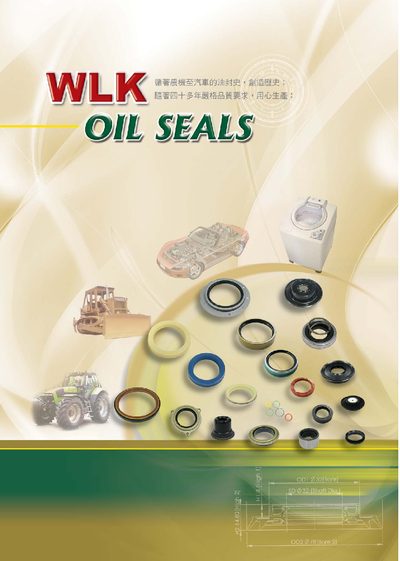
This WLK oil seals manual describes WLK radial shaft seals, which are lip contact sealing components for O.D. press-fit installation. A garter spring normally provides consistent radial load on the sealing lip, and the document covers standard seal designs with single or twin lips, with or without metal cases and springs.
It also lists factors affecting sealing, installation instructions, and material operating temperature ranges for Nitrile, Polyacrylic, Silicone, Fluoro Elastomer, and Leather. An inventory list of available WLK oil seal sizes is included in the appendix.
| Maximum inner diameter (NSF certified seal) | 14 mm |
|---|---|
| Maximum outer diameter (NSF certified seal) | 25.3 mm |
| Maximum height (NSF certified seal) | 7.2 mm |
| Nitrile (Buna N) operating temperature | –65 to 225˚F (–18 to 107˚C) |
| Fluoro Elastomer operating temperature | –40 to 400˚F (–5 to 205˚C) |
Materials may include NBR (Nitrile), Polyacrylic compound (PA), Silicone, Fluoro-elastomer (Viton), or Leather.
A garter spring normally provides the consistent radial load.
It excludes foreign matter from the primary sealing lip.