
The LTC2289 is a 10-bit 80Msps, low noise 3V dual A/D converter designed for digitizing high frequency, wide dynamic range signals. The LTC2289 is perfect for demanding imaging and communications applications with AC performance that includes 61.6dB SNR and 85dB SFDR for signals well beyond the Nyquist frequency.
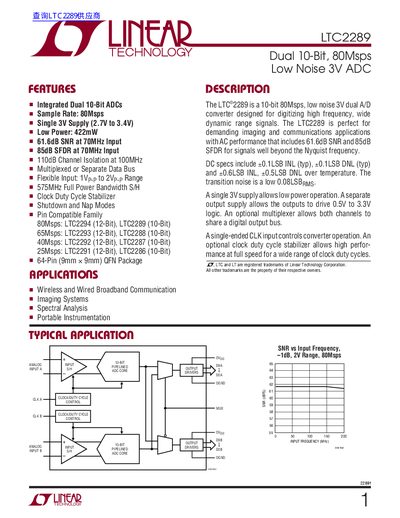
The LTC2289 is a dual 10‑bit analog‑to‑digital converter designed for high‑frequency, wide‑dynamic‑range applications such as imaging and communications. It operates from a single 3 V supply (2.7 V‑3.4 V) and offers low power consumption (typical 422 mW) while delivering 61.6 dB signal‑to‑noise ratio and 85 dB spurious‑free dynamic range at 5 MHz input.
The device is offered in a 64‑lead plastic QFN package (9 mm × 9 mm) and provides flexible I/O options, including separate analog and digital supplies, optional multiplexed data bus, and programmable reference and shutdown modes. Detailed specifications cover absolute maximum ratings, converter characteristics, timing, pin functions, and recommended solder‑pad dimensions.
| Resolution | 10 bits (no missing codes) |
|---|---|
| Maximum Sampling Rate | 80 Msps |
| Typical SNR (5 MHz input) | 61.6 dB |
| Typical SFDR (5 MHz input) | 85 dB |
| Power Dissipation (typical) | 422 mW |
| Supply Voltage | 3 V (2.7 V‑3.4 V) |
| Package | 64‑lead plastic QFN (9 mm × 9 mm) |
The LTC2289 can sample at up to 80 Msps.
Typical SNR is 61.6 dB for a 5 MHz input signal.
Typical power dissipation is 422 mW for both channels at full speed.
It is supplied in a 64‑lead plastic QFN package measuring 9 mm × 9 mm.