
This document describes a low EMI clock generator model C9869, designed for Intel 815 chipset systems. The product features multiple clock outputs, including CPU clock, SDRAM clock, PCI clock, etc. It also supports IMI Spread Spectrum technology and various adjustable parameters. The product is available in a 56-pin SSOP package.
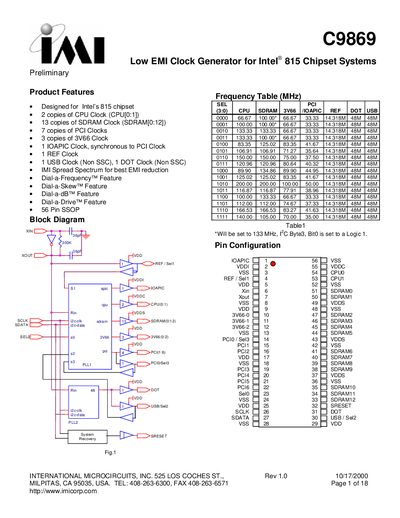
This manual describes the features of the IMI C9869 Low EMI Clock Generator designed for Intel® 815 chipset systems. It includes a full pin‑out diagram, frequency tables, and details of the spread‑spectrum and clock‑selection functions.
The document also covers the 2‑wire I²C control interface, system self‑recovery behavior, recommended crystal oscillator parameters, and mechanical package dimensions, giving designers the information needed to integrate and program the device.
| Package type | 56 Pin SSOP |
|---|---|
| Operating temperature range | 0 °C to 70 °C (Commercial) |
| Crystal frequency range | 12.00 MHz – 16.00 MHz |
| IOAPIC clock output voltage | 2.5 V |
| CPU clock register enable | 1 = Enable, 0 = Disable |
Pins 4, 14, and 30 are power‑up bi‑directional pins used to select the host frequency; after latching they become clock outputs.
The SRESET pin is an active‑low output that generates a 3 ms pulse to reset the system when programmed.
A crystal with a frequency between 12 MHz and 16 MHz, tolerance ±100 ppm, and load capacitance of 20 pF is recommended.
Yes, the System Self Recovery feature allows frequency changes during operation and can reboot the system if a hang occurs.