
SJ-RC161 platinum resistance temperature sensor works on the principle that the resistance of the thin film platinum resistance changes with the temperature, and the relationship between resistance and temperature (i.e., the division characteristic) is completely the same as the IEC standard. At the same time, the platinum resistance sensor has good long-term stability. If the temperature transmitter is matched, it can output 4~20mA or other standard signals, which is more convenient to use. SJ-RC161 platinum resistance temperature sensor adopts three-wire lead-out method, which can effectively compensate the measurement error caused by lead resistance in combination with temperature transmitter.
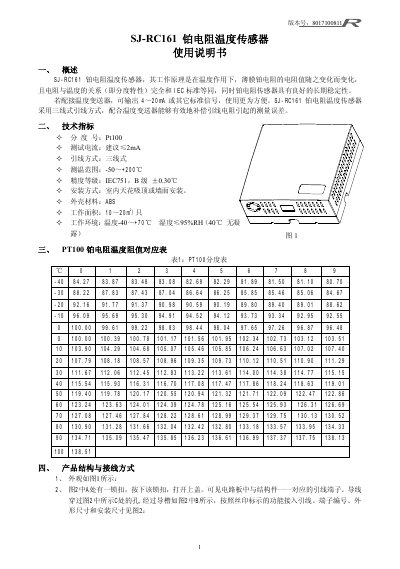
The SJ‑RC161 platinum resistance temperature sensor operates on the principle that the resistance of a thin‑film platinum element changes with temperature, matching IEC standards and offering long‑term stability. When paired with a temperature transmitter it can output standard 4‑20 mA signals for convenient use.
The manual details technical specifications, a resistance‑temperature table, product structure, wiring diagrams, and important installation precautions such as recommended test current, placement distances from air vents, and wiring consistency to minimize measurement error. This manual is written in Chinese.
| Sensor type | Pt100 |
|---|---|
| Test current | ≤2 mA |
| Wiring method | Three‑wire |
| Temperature range | -50 °C to +200 °C |
| Accuracy class | IEC751 B ±0.30 °C |
| Installation method | Indoor ceiling or wall |
| Enclosure material | ABS |
| Working area per sensor | 10–20 m² |
| Operating temperature | -40 °C to +70 °C |
| Maximum humidity | ≤95 %RH (40 °C, no condensation) |
The manual recommends a test current of 2 mA or less.
The sensor should be placed more than 1.5 m from a horizontal air supply vent and more than 0.5 m from a ceiling vent.
It uses a three‑wire lead with terminals 1 and 2 internally shorted and terminal 3 providing the output.
The sensor can measure temperatures from –50 °C up to +200 °C.