
The 3052 accelerometer is a temperature compensated silicon MEMS accelerometer. The accelerometer is packaged in a ceramic base with a ceramic housing sealed with epoxy resin, designed for adhesive mounting. The accelerometer provides a range from 2g to 100g and has a minimum 1500Hz smooth frequency response. The silicon MEMS sensor is gas damped and has an over range stop function for high G shock protection.
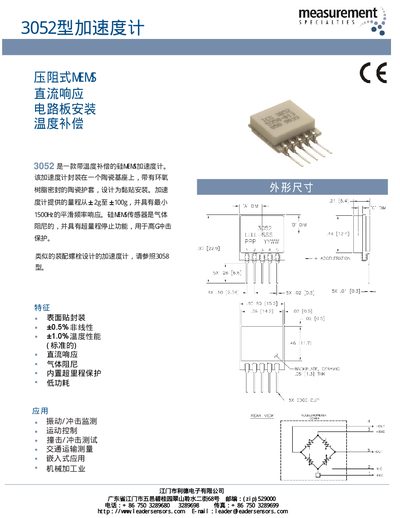
This manual describes the 3052 type accelerometer, a piezo‑resistive sensor mounted on a ceramic base with a resin‑sealed housing. It outlines the measurement range, performance parameters, and physical characteristics of the device.
Installation details, pin assignments, and wiring diagrams are included, along with a table of electrical specifications such as sensitivity, output impedance, and temperature limits. The document also provides model codes and example configurations for different measurement ranges. This manual is written in Chinese.
| Measurement range | +2g to +100g |
|---|---|
| Minimum resonant frequency | 1500 Hz |
| Temperature coefficient | +1.0 %/°C |
| Operating temperature range | -40 °C to +125 °C |
| Output impedance | 1900 Ω |
The device measures from +2 g up to +100 g.
It can operate from –40 °C to +125 °C.
The sensor is powered by a DC excitation of 2 V to 10 V (commonly 5 V).