
This document describes the features and characteristics of the T7126M RF ID card reader module.
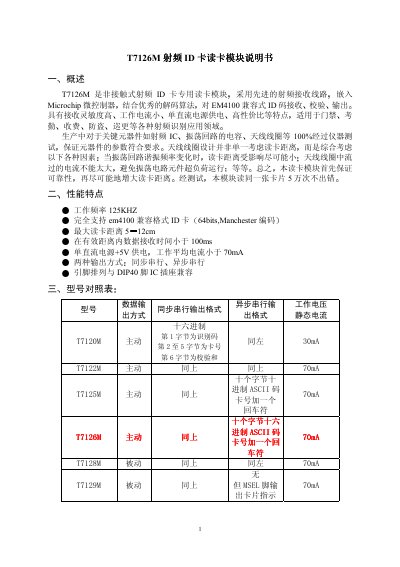
The T7126M is a non‑contact RFID ID card reader module that uses a Microchip microcontroller and advanced decoding algorithms. It supports EM4100‑compatible 125 kHz cards and is suited for access control, attendance, fee collection, anti‑theft and patrol applications.
The document provides electrical and mechanical specifications, wiring diagrams for synchronous and asynchronous serial output, and practical guidance on PCB layout, antenna design, and troubleshooting. It also includes example VB code for PC serial communication and recommendations for minimizing interference to achieve the maximum read distance. This manual is written in Chinese.
| Working frequency | 125 kHz |
|---|---|
| Supported card format | EM4100 compatible, 64‑bit ID |
| Maximum read distance | 5‑12 cm |
| Supply voltage | +5 V |
| Average operating current | < 70 mA |
| Output current (So, Sck, CP) | 25 mA |
| Operating temperature range | -40 °C to +70 °C |
When using asynchronous serial output, the module’s TX/RX signals are level‑shifted by a MAX232 driver, allowing direct connection to a PC’s RS‑232 port.
The module provides two output modes: synchronous serial and asynchronous serial.
Both output modes operate at a baud rate of 9600 bits/s.
After reading a card, perform a checksum verification and ensure the card number length is correct; discard data that is all zeros or fails the checksum.