
SLET1000-A is a portable fieldbus data acquisition instrument, mainly used for the core acquisition system of the Sobo online monitoring system. The instrument has features such as secondary development communication protocol, bus wiring, and convenient networking. It supports a maximum of 70 nodes, with up to 24 channels per node, and supports a total of 300 channels.
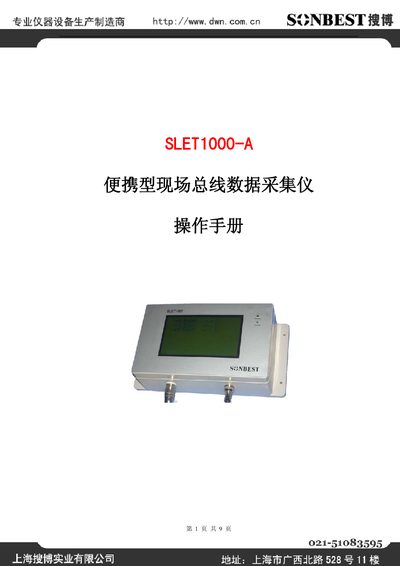
The SLET1000-A is a data‑collection instrument that can connect up to 70 points, with a maximum of 100 point IDs and up to 24 channels per point, for a total of 300 channels. It communicates with a host PC via RS232 (optionally CAN, RS485 or Ethernet) and is powered by a 24 V DC supply.
The manual details the command protocol (ASCII‑based commands starting with '@'), communication settings (19200‑baud, 8‑N‑1), power‑supply recommendations, and procedures for reading and writing sensor IDs, channel numbers, and 64‑bit serial numbers. It also describes additional functions such as storing point‑status information. This manual is written in Chinese.
| Maximum number of points | 70 |
|---|---|
| Maximum point ID | 100 |
| Maximum channels per point | 24 |
| Maximum total channels | 300 |
| Baud rate | 19200 |
| Communication interface | RS232 (optional CAN, RS485, Ethernet) |
| Power supply | DC 24 V 1 A |
| Weight | 1000 g |
| Operating temperature | -40 °C to +85 °C |
| Storage temperature | -20 °C to +80 °C |
| Dimensions | 200 mm × 70 mm × 175 mm |
The device uses a baud rate of 19200, 8 data bits, 1 stop bit, and no parity; these settings cannot be changed.
Each point can have up to 24 channels connected.
The instrument requires a DC 24 V supply rated at 1 A; for many sensors a 2‑3 A supply is recommended.
Use the '@W' command with the channel address, sensor position, and the 64‑bit serial number in ASCII format.