
This document is about German-made products of asymmetric field flow fractionation chromatography. The product has efficient separation performance and reliable performance, suitable for the analysis of various complex samples. It adopts advanced technology and design, and can provide accurate and reliable analysis results.
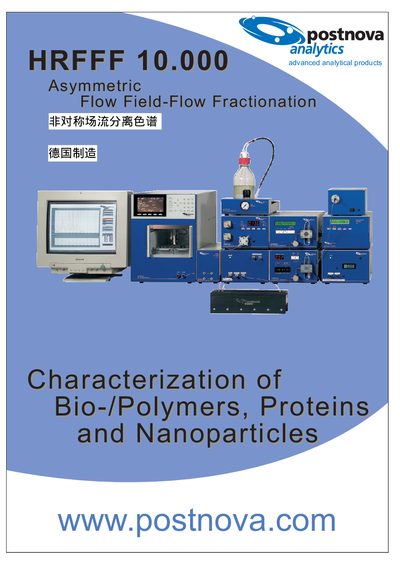
The HRFFF 10.000 is an advanced analytical instrument designed for field‑flow fractionation of particles and polymers. It supports a wide range of sample sizes, membrane options, and detector configurations, enabling flexible analysis of nanometer‑scale to micrometer‑scale materials.
Key specifications include particle size handling from 1 nm to 100 nm, polymer molar mass up to 10 Da, analysis times of 1–60 min, laminar and cross‑flow rates of 0–10 mL/min, pressure limits up to 31 bar, and operating temperatures from 5 °C to 45 °C. The system runs on 110 V or 240 V power, requires a Windows PC with at least 32 MB RAM, and uses NovaFFF Control software for operation.
| Particle size range | 1 nm to 100 |
|---|---|
| Polymer molar mass range | 10° Da to 10” Da |
| Analysis time | 1 to 60 min, typically 15‑20 min |
| Laminar flow range | 0‑10 mL/min |
| Pressure limit | 0‑31 bar |
| Power requirements | 110V or 240V, 50/60 Hz, 2.5 A |
It can handle particles from 1 nm up to 100 nm.
Both laminar and cross‑flow rates are adjustable from 0 to 10 mL/min.
It operates on either 110 V or 240 V, 50/60 Hz, drawing about 2.5 A for a basic setup.