
This document introduces the technical specifications of the high-speed Si PIN photodetectors GT106 and GT106-A, including the photosensitive area diameter, spectral response range, responsivity, response time, coupling loss, dark current, breakdown voltage, capacitance, operating voltage, etc. The photodetectors adopt a Si-PIN inner and outer tube composite structure and have features such as a planar positive illumination structure, fast response, low dark current, high responsivity, and high reliability. They can be used in applications such as ranging, transient processes, fast optical signal detection, and fiber optic communication.
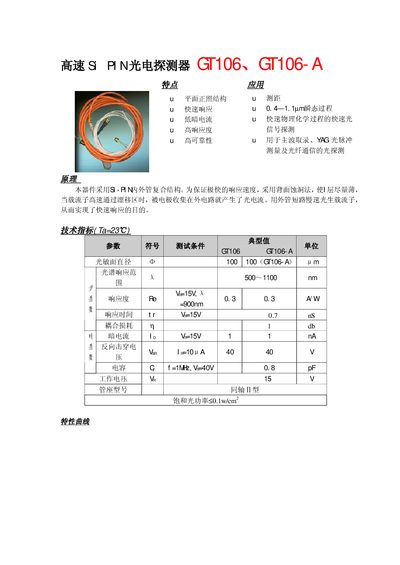
The GT106 and GT106‑A are high‑speed Si‑PIN photoelectric detectors featuring a fast response, low dark current, and high reliability. They use an S‑RN inner‑outer tube composite structure with a back‑etched thin layer to achieve rapid carrier drift and collection, enabling fast optical signal detection for applications such as YAG laser pulse measurement and fiber‑optic communication.\n\nThe device operates under reverse bias and requires careful handling: avoid strong vibration or impact, clean fiber connectors with alcohol and lint‑free cotton before use, and maintain strict electrostatic protection during storage and operation to prevent damage to the optical window and fiber. This manual is written in Chinese.
Clean the fiber connector with alcohol and lint‑free cotton before connecting.
Prevent strong vibration or impact, keep the device under reverse bias, and use strict electrostatic protection during storage and use.