
PY-C type telephone remote control board is a telephone remote control board with the lowest development cost, which can control 1 relay switch, AC contact: 220V, current: 3A, input voltage: 9-12V.
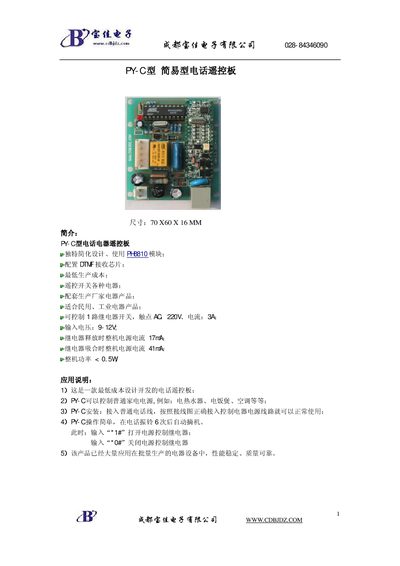
The PY-C telephone remote control board is a low‑cost design that uses a PH8810 module and a DTMF receiver chip to control a single relay. It can switch various household and industrial appliances such as water heaters, rice cookers, and air conditioners by dialing simple codes after the phone rings six times.
Installation requires connecting the board to a standard telephone line and wiring the appliance power line according to the provided wiring diagram. Operation is performed by dialing *1# to turn the relay on and *0# to turn it off. The board operates from a 9‑12 V supply and consumes less than 0.5 W. This manual is written in Chinese.
| Dimensions | 70 × 60 × 16 mm |
|---|---|
| Relay Contact Rating | AC 220 V, 3 A |
| Input Voltage | 9‑12 V |
| Relay Release Current | 17 mA |
| Relay Pull‑in Current | 41 mA |
| Power Consumption | < 0.5 W |
After the phone rings six times, dial *1# to close the relay and power the appliance.
After the phone rings six times, dial *0# to open the relay and cut power to the appliance.
The relay contacts are rated for AC 220 V at up to 3 A.
The board operates from a 9 V to 12 V DC supply.