
This document introduces the use of FB-PLC, including the logic principle of ladder diagram and the translation rules of mnemonic instructions.
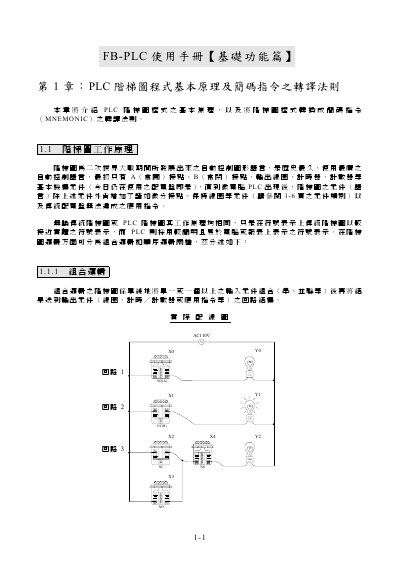
This manual introduces the basic principles of PLC ladder‑logic programs and the translation rules for converting ladder diagrams into mnemonic (MNEMONIC) instructions. It covers both combination logic and sequential logic, showing how inputs and outputs are processed in typical circuits.
The document also compares traditional ladder diagrams with PLC ladder diagrams, details the structure and terminology of ladder programs, and provides guidelines for using temporary relay (TR) instructions and simplifying programs. Technical specifications such as scan time and network size are included. This manual is written in Chinese.
| Scan time per 1K step contact | 0.33 ms |
|---|---|
| Maximum network size | 22 rows × 16 columns |
The scan time for a 1K step contact is only 0.33 ms.
The maximum network size is 22 rows by 16 columns.
Ladder diagrams use combination logic and sequential logic.