
The SS-9261 radar detector uses a microwave dedicated microprocessor, not only has high detection sensitivity, wide detection range, but also works very reliably, with an extremely low false alarm rate. It can work stably in a temperature range of -25 to +45 degrees, and is most suitable for use as a human or object movement detection sensor in mid-to-high-end security alarm systems.
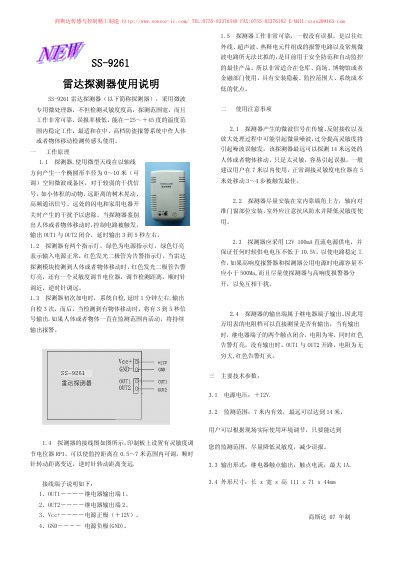
This manual describes the working principle of the SS-9261 radar detector, including its microwave sensing area, detection of human or object movement, and the resulting relay outputs. It also explains the indicator lights, sensitivity adjustment, and self‑test behavior on power‑up.
Installation notes cover wiring connections (OUT1, OUT2, Vcc+, GND), recommended mounting locations, power supply requirements, and precautions to avoid false alarms. The document ends with the main technical specifications such as power voltage, monitoring range, output type, dimensions, and operating temperature. This manual is written in Chinese.
| Power supply voltage | +12 V |
|---|---|
| Monitoring range | Effective up to 7 m, maximum 14 m |
| Output type | Relay contact output, max 1 A |
| Dimensions | 111 mm × 71 mm × 44 mm |
| Operating temperature | -25 °C to +45 °C |
It requires a 12 V DC supply with at least 100 mA current, and the voltage must not drop below 10.5 V during operation.
The detector reliably detects movement within 7 m, and can reach up to 14 m under optimal conditions.
When triggered, the detector closes relay contacts on OUT1 and OUT2, each capable of up to 1 A current; the contacts show zero resistance when closed.