
The HP-408-C Human Body Sensor Module (Open Collector Output Type) is an automatic control product based on infrared technology. It has high sensitivity, strong reliability and is widely used in various automatic sensing electrical appliances. The module has full automatic sensing, two trigger modes (optional), has a sensing blocking time, adjustable delay time, working voltage, micro power consumption, and small size.
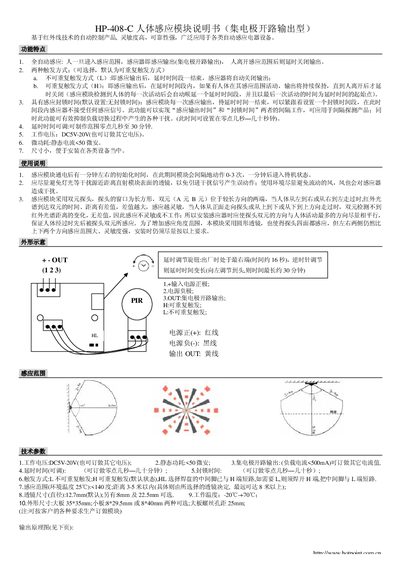
The HP-408-C is an infrared‑based body induction module that automatically detects a person entering its sensing range and outputs a collector‑open (dry‑contact) signal. It offers two trigger modes—non‑repetitive and repetitive—adjustable delay time, optional lockout time, and a compact size for easy mounting in various equipment.
The manual explains the initial one‑minute power‑on initialization, recommended installation orientation of the dual‑element probe, wiring connections (positive red line, negative black line, and OUT yellow line), and how to set the delay, lockout, and trigger mode using the adjustment knob and solder bridges. Technical parameters such as operating voltage, static current, sensing distance, and lens options are also listed. This manual is written in Chinese.
| Working voltage | DC5V‑20V |
|---|---|
| Static current | <50 µA |
| Output type | Collector open‑circuit, load current <500 mA |
| Adjustable delay time | 0.1 s – 30 min |
| Sensing angle | <140° |
| Operating temperature | -20°C to 70°C |
| Lens diameter | 12.7 mm (default), optional 8 mm or 22.5 mm |
| Dimensions | Large board 35×35 mm; small board 8×29.5 mm or 8×40 mm |
Turn the delay adjustment knob; factory setting is at the rightmost position (~16 s) and can be increased up to about 30 minutes.
Mount the dual‑element probe so its direction is parallel to the most common direction of human movement.