
This document describes a reagent kit for detecting Norovirus G1 gene. The kit is intended for research use only and should not be used for clinical diagnosis or treatment. Additionally, it should not be used directly on human or animal bodies for purposes such as medical, cosmetic, or food applications.
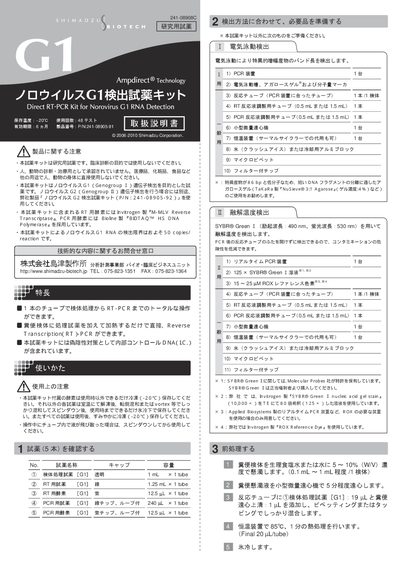
The Shimadzu Direct RT-PCR Kit for Norovirus G1 RNA Detection is a research reagent designed to detect Genogroup 1 norovirus genes. It utilizes Ampdirect technology to allow total operation from sample processing to RT-PCR in a single tube, simplifying the workflow for stool sample analysis.
The kit includes internal control DNA (IC) to prevent false negatives and supports two detection methods: electrophoresis to detect specific amplification product band lengths and melting temperature detection using SYBR Green I. This manual is written in Japanese.
| Detection Limit | Approximately 50 copies/reaction |
|---|---|
| Storage Temperature | -20°C |
A separate product, the Norovirus G2 Detection Reagent Kit (CP/N: 241-08905-92), should be used.
This reagent kit is intended for the detection of Norovirus G1 (Genogroup 1) genes.
The extraction limit is approximately 50 copies/reaction.
The enzymes should be stored frozen at -20C whenever they are not in use.