
Orbisint CPS11 and CPS11D are pH electrodes for standard applications in process and environmental technology, with a hydrophobic PTFE diaphragm and an integrated temperature sensor.
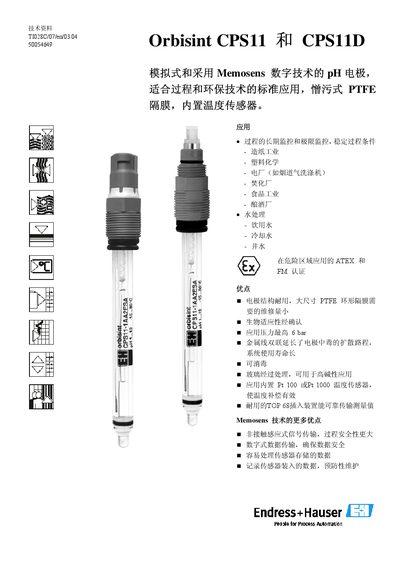
The Orbisint CPS11 and CPS11D are analog and Memosens digital pH electrodes designed for process and environmental monitoring. They feature a PTFE ring diaphragm, built‑in temperature sensor (Pt 100/Pt 1000 for CPS11, NTC for CPS11D) and ATEX/FM hazardous‑area certifications.
The document provides measurement ranges, pressure and temperature limits, connector options (ESA TOP68, GSA DIN, Memosens digital), mechanical dimensions, weight, material details and ordering codes, as well as recommended installation practices and cable accessories. This manual is written in Chinese.
| Measurement range (AA type) | pH 0‑12 |
|---|---|
| Temperature range (AA type) | -15 °C to 80 °C |
| Measurement range (BA type) | pH 0‑14 |
| Temperature range (BA type) | 0 °C to 135 °C |
| Maximum pressure | 6 bar |
| Weight | ≈0.1 kg |
| Electrode rod material | Treated glass |
| Temperature sensor (CPS11) | Pt 100 / Pt 1000 |
| Temperature sensor (CPS11D) | NTC |
The CPS11 sensor is rated for a maximum pressure of 6 bar.
The BA type electrode operates from 0 °C up to 135 °C.