
DNS-MRC-100 is an intelligent forward and reverse control device, suitable for single-phase or three-phase 110VAC/220VAC, power 1/8HP-1HP motor forward and reverse control, mainly used in industrial machine tool chip removers, automated conveyors and other fields.
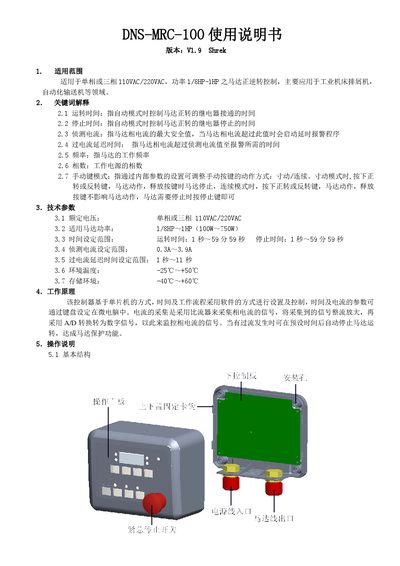
The DNS‑MRC‑100 is an intelligent forward/reverse motor controller designed for single‑phase or three‑phase 110 VAC/220 VAC motors ranging from 1/8 HP to 1 HP. It is commonly used in industrial machines such as chip‑removal devices and automated conveyors.
The document covers technical parameters, panel description, parameter configuration, automatic and manual operation, alarm codes, wiring diagrams for single‑ and three‑phase power, installation requirements, maintenance procedures, fault diagnosis and safety precautions. This manual is written in Chinese.
| Rated Voltage | 单相或三相 110VAC/220VAC |
|---|---|
| Motor Power Range | 1/8HP~1HP(100W~750W) |
| Operating Time Range | 1 s ~ 59 min 59 s |
| Stop Time Range | 1 s ~ 59 min 59 s |
| Detect Current Range | 0.3 A ~ 3.9 A |
Press and hold the key for 2 seconds until “P1” appears, then use the increase/decrease keys to adjust the operating time; repeat for stop time with “P1” again.
E1 is an over‑current alarm; the motor stops, the controller reverses for a preset time, and if the condition persists the unit shuts down with all indicators lit.
The controller uses a 5X20 6.3 A/250 V fast‑blow fuse; open the fuse holder, remove the old fuse and install a new one of the same rating.
Connect the IN terminal block to ground (TG), the OUT terminal block to the motor housing, and then connect each phase (R, U, S, V, T, W) to the corresponding motor leads.