
Key facts
- Manuals
- 1
- Languages
- EN
- Last added
- 2023-11-29
Featured Silverpop manuals
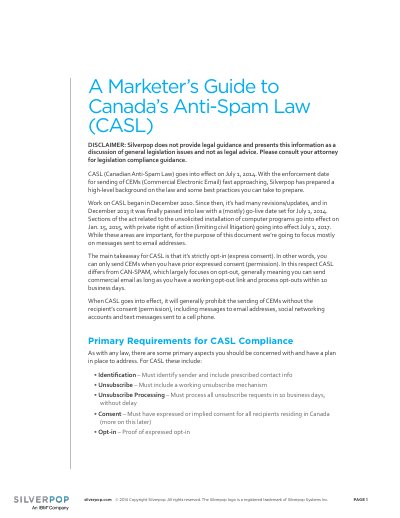
Silverpop A Marketer's Guide to Canada's Anti-Spam Law (CASL)
This 2014 Silverpop guide discusses Canada's Anti-Spam Law (CASL) and its main requirements for commercial electronic messages. It covers express and implied consent, the July 1, 2014 effective date, and transitional provisions for existing contacts.
The document also lists exclusions and exemptions, explains what an email seeking express consent must contain, describes how transactional emails are handled, and compares CASL with CAN-SPAM.
Covers: Primary Requirements for CASL Compliance · What Is Consent? · Transitional Provision for Existing Email Contacts (Implied Consent) · What Does CASL Mean to You? · Exclusions & Exemptions · What’s Required in an Email When Seeking Express Consent?
Latest Silverpop manuals
Silverpop A Marketer's Guide to Canada's Anti-Spam Law (CASL)
Other 7 pages · 227 KB · ENSilverpop guide explaining Canada's Anti-Spam Law (CASL), consent types, compliance requirements, exemptions, and differences from CAN-SPAM.
Questions answered in Silverpop manuals
When does CASL go into effect?
CASL goes into effect on July 1, 2014, with some sections starting later.
From: Silverpop A Marketer's Guide to Canada's Anti-Spam Law (CASL)
What are the primary requirements for CASL compliance?
The guide lists identification, a working unsubscribe mechanism, processing unsubscribe requests in 10 business days, consent, and proof of express opt-in.
From: Silverpop A Marketer's Guide to Canada's Anti-Spam Law (CASL)