
Key facts
- Manuals
- 1
- Languages
- EN
- Last added
- 2023-11-16
Featured Osteoporosis Canada manuals
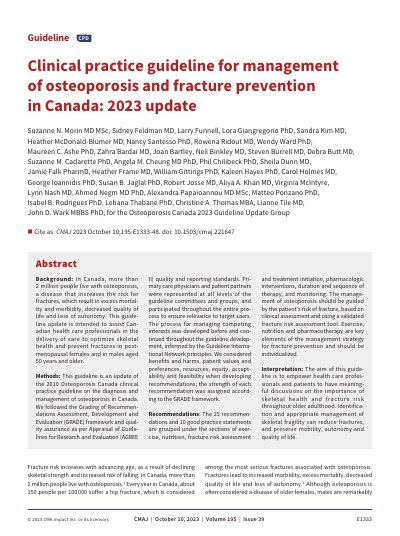
Osteoporosis Canada 2023 Clinical Practice Guideline for Management of Osteoporosis and Fracture Prevention
This is the 2023 update of the Osteoporosis Canada clinical practice guideline on the diagnosis and management of osteoporosis in Canada, published in CMAJ and developed by the Osteoporosis Canada 2023 Guideline Update Group. It is intended to help Canadian primary health care professionals screen community-dwelling postmenopausal females and males aged 50 years and older for risk factors for osteoporosis and fractures, and to provide interventions to optimize skeletal health and prevent fractures. The recommendations were developed with the GRADE framework, with quality assurance and reporting per AGREE II, and with primary care physicians and patient partners involved throughout.
The guideline contains 25 recommendations and 10 good practice statements grouped under exercise, nutrition, fracture risk assessment and treatment initiation, pharmacologic interventions, duration and sequence of therapy, and monitoring. Management should be guided by the patient's risk of fracture, based on clinical assessment with a validated fracture risk assessment tool (FRAX or CAROC), with exercise, nutrition and pharmacotherapy as key elements of an individualized strategy. The guideline notes that it does not address patients with cancer or other serious illnesses that can induce bone loss, and refers readers elsewhere for detailed fall prevention guidance.
Covers: Methods · Scope · Recommendations and good practice statements · Exercise · Nutrition · Fracture risk assessment and treatment initiation
Latest Osteoporosis Canada manuals
Osteoporosis Canada 2023 Clinical Practice Guideline for Management of Osteoporosis and Fracture Prevention
Other 16 pages · 182 KB · EN2023 update of Osteoporosis Canada's clinical practice guideline on managing osteoporosis and preventing fractures in adults aged 50 and older.
Questions answered in Osteoporosis Canada manuals
What bone mineral density T-score indicates osteoporosis?
Osteoporosis is defined as a bone mineral density of 2.5 or more standard deviations below peak bone mass, that is, a T-score of -2.5 or lower.
When can a clinical diagnosis of osteoporosis be made?
In people aged 50 years and older who have had a low-trauma hip, vertebral, humerus or pelvic fracture after age 40, or who have an absolute fracture risk of 20% or more over the next 10 years using FRAX or CAROC.