
Key facts
- Manuals
- 1
- Languages
- ZH
- Last added
- 2023-11-15
Featured TSRC manuals
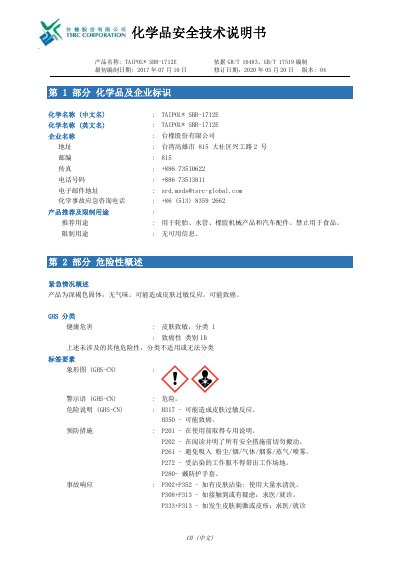
TSRC TAIPOL SBR-1712E Rubber Safety Data Sheet
This is the Chinese-language chemical safety data sheet (version 04, revised 2020-05-20) for TAIPOL SBR-1712E from 台橡股份有限公司 (TSRC), prepared according to GB/T 16483 and GB/T 17519. It identifies the product as a dark brown, odorless solid and lists its components with CAS numbers and content ranges, led by 丁苯橡胶 (CAS 9003-55-8) at > 65.9 %, together with a heavy paraffinic solvent extract, hydrogenated tallow fatty acid, rosin and a minor mixture component.
The sheet gives GHS classification as skin sensitization category 1 and carcinogenicity category 1B, with the signal word Danger and hazard statements H317 and H350. It then sets out first aid, firefighting measures, spill response, safe handling and storage, exposure controls and personal protective equipment, physical and chemical properties, stability and reactivity, toxicological and ecological information, disposal, transport information (not regulated as dangerous goods) and regulatory listings. Recommended use is for tires, hoses, rubber mechanical products and auto parts, and use in food is prohibited. This manual is written in Chinese.
Covers: Chemical and company identification · Hazard identification (GHS) · Composition / ingredient information · First aid measures · Firefighting measures · Accidental release measures
Latest TSRC manuals
TSRC TAIPOL SBR-1712E Rubber Safety Data Sheet
Datasheet 9 pages · 330 KB · ZHChinese safety data sheet for TSRC TAIPOL SBR-1712E rubber: composition, GHS hazards, first aid, handling, storage, transport and regulatory information.
Which document do I need?
Datasheet
Ratings, dimensions and ordering codes, for selection and design work.
Questions answered in TSRC manuals
What is TAIPOL SBR-1712E used for?
It is recommended for tires, water hoses, rubber mechanical products and auto parts. Use in food is prohibited.
What are the main hazards of TAIPOL SBR-1712E?
It may cause an allergic skin reaction and may cause cancer, and it is labeled with the signal word Danger.