
Key facts
- Manuals
- 1
- Languages
- ZH
- Last added
- 2023-11-03
Featured MicroSHENTEK manuals
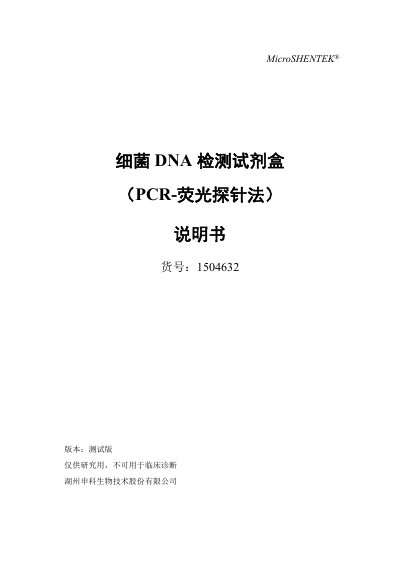
MicroSHENTEK Bacteriology DNA Detection Kit (PCR-Fluorescent Probe Method) Instructions for Use
The MicroSHENTEK Bacteriology DNA Detection Kit (PCR-Fluorescent Probe Method), product number 1504632, is designed for the qualitative detection of bacterial contamination in cells, cell products, and vaccines. Utilizing fluorescence probe qPCR technology, the kit covers approximately 92% of known bacterial species and has a detection limit of 100 CFU. It is intended for research use only and is not for clinical diagnosis.
The manual provides detailed instructions for preparing the qPCR reaction mix, adding samples, and operating the procedure on compatible real-time PCR systems such as the SHENTEK-96S, 7500 Real-Time PCR System, and Roche LightCycler 480 II. It includes specific steps for setting up controls (NTC, NCS, PC, PCS) and interpreting results based on Ct values and amplification curves. This manual is written in Chinese.
Covers: Kit Introduction · Kit Components · Required Materials and Equipment · Experimental Preparation · qPCR Reaction Mix Preparation · Sample Addition
Latest MicroSHENTEK manuals
MicroSHENTEK Bacteriology DNA Detection Kit (PCR-Fluorescent Probe Method) Instructions for Use
User Manual 8 pages · 277 KB · ZHInstructions for using the MicroSHENTEK Bacteriology DNA Detection Kit (PCR-Fluorescent Probe Method) to qualitatively detect bacterial contamination in…
Which document do I need?
User Manual
Day-to-day operation, settings and troubleshooting. Start here if the product is already set up.
Questions answered in MicroSHENTEK manuals
Is this kit suitable for clinical diagnosis?
No, the kit is for research use only and is not intended for clinical diagnosis.
From: MicroSHENTEK Bacteriology DNA Detection Kit (PCR-Fluorescent Probe Method) Instructions for Use
What is the detection limit of the kit?
The detection limit is 100 CFU.
From: MicroSHENTEK Bacteriology DNA Detection Kit (PCR-Fluorescent Probe Method) Instructions for Use