
Key facts
- Manuals
- 1
- Languages
- EN
- Last added
- 2023-11-03
Featured Federal Ministry of Health manuals
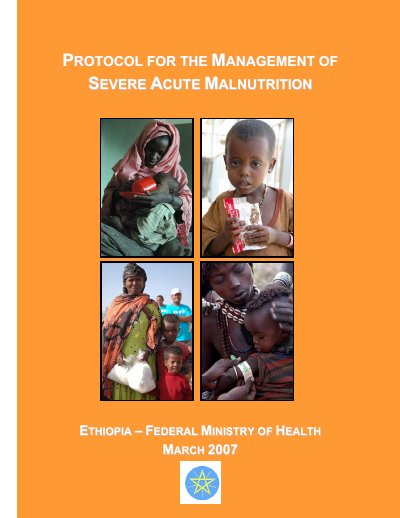
Ethiopia Federal Ministry of Health Protocol for the Management of Severe Acute Malnutrition
This protocol is an update of the May 2004 guideline for the management of severe malnutrition. It was edited and compiled by Sylvie Chamois, Michael Golden and Yvonne Grellety, reviewed by national and international experts, and endorsed by Ethiopia's Federal Ministry of Health in 2007. It sets out how severely malnourished patients are treated in a Therapeutic Feeding Unit, in hospital or in the community.
The document has two main parts: treatment from six months of age to adulthood, and treatment of infants under six months. It covers implementation modalities, admission criteria and procedures, routine medicines, Phase 1, the Transition Phase and Phase 2, treatment of complications, failure to respond, discharge criteria, play and stimulation, community mobilisation, HIV/AIDS and malnutrition, health and nutrition information, recording and reporting, and annexes.
Covers: Implementation Modalities · Admission Criteria and Procedures · Routine Medicines · Phase 1 (In-patients) · Treatment of Complications · Transition Phase
Latest Federal Ministry of Health manuals
Ethiopia Federal Ministry of Health Protocol for the Management of Severe Acute Malnutrition
Other 121 pages · 3 MB · ENEthiopia's Federal Ministry of Health protocol for treating severe acute malnutrition in children from six months to adulthood, and in infants under six months.
Questions answered in Federal Ministry of Health manuals
How is severe acute malnutrition defined in the protocol?
It is severe when the wasting is severe, measured as weight-for-height below 70% of the NCHS median or a low MUAC, or when oedema is present. Oedematous cases are always classified as severe.
From: Ethiopia Federal Ministry of Health Protocol for the Management of Severe Acute Malnutrition
What mortality rate does the protocol say should be achieved?
If the guidelines are carefully followed, the mortality rate should be less than 5%, even in areas with a high prevalence of HIV/AIDS.
From: Ethiopia Federal Ministry of Health Protocol for the Management of Severe Acute Malnutrition