
Key facts
- Manuals
- 1
- Languages
- ES
- Last added
- 2023-10-31
Featured PNUD manuals
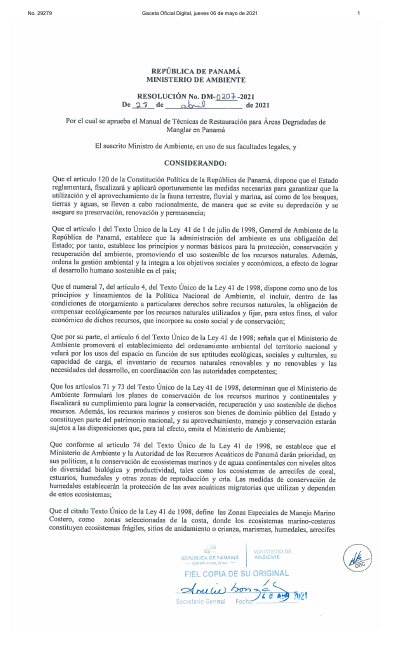
PNUD Manual of Restoration Techniques for Degraded Mangrove Areas in Panama
This manual was published by PNUD and Panama's Ministerio de Ambiente (MiAMBIENTE) within the project "Protección de reservas y sumideros de carbono, en los manglares y áreas protegidas de Panamá", with Arturo Zaldívar-Jiménez as main author. The suggested citation gives the year 2020 and ISBN 978-9962-8511-4-1, and the text appears in Gaceta Oficial Digital No. 29279 of May 6, 2021.
The pages shown cover the monitoring of mangrove soil and interstitial water variables — salinity, temperature, pH, redox potential, nutrients and sulfide — describing for each one its level, its application as an ecological indicator and the sampling method, with three replicates per sampling unit (A and B) and a monitoring frequency of every three months. This manual is written in Spanish.
Covers: Salinity (surface and interstitial) · Temperature (surface and interstitial) · Hydrogen potential (pH) · Oxidation-reduction potential (Redox) · Interstitial water nutrients · Sulfide concentration (S-2)
Latest PNUD manuals
PNUD Manual of Restoration Techniques for Degraded Mangrove Areas in Panama
Other 103 pages · 15 MB · ESTechnical manual from PNUD and MiAMBIENTE on techniques for restoring degraded mangrove areas in Panama, including monitoring of soil and water variables.
Questions answered in PNUD manuals
At what depth is the soil pH measured?
The pH is measured at 30 cm soil depth, using a pH sensor connected to a potentiometer or a multiparameter probe.
From: PNUD Manual of Restoration Techniques for Degraded Mangrove Areas in Panama
How often is monitoring carried out?
The monitoring frequency is every three months, with three replicates per sampling unit (A and B).
From: PNUD Manual of Restoration Techniques for Degraded Mangrove Areas in Panama