
Key facts
- Manuals
- 1
- Languages
- ZH
- Last added
- 2023-10-31
Featured China Academy of Engineering Physics manuals
China Academy of Engineering Physics Ultra-wideband Planar Power Divider/Combiner Patent Application CN 110890614 A
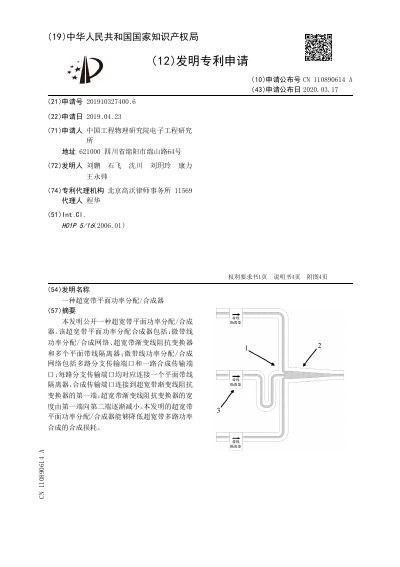
This Chinese patent application (CN 110890614 A) from the Institute of Electronic Engineering, China Academy of Engineering Physics, describes an ultra-wideband planar power divider/combiner. The device comprises a microstrip power distribution/synthesis network, an ultra-wideband tapered-line impedance transformer, and multiple planar stripline isolators. The design aims to lower multi-channel, multi-stage synthesis loss by directly combining signals from multiple isolators through the microstrip network and outputting via the tapered transformer.
The claims specify that each branch transmission line has 50 Ω impedance, while the combined transmission line impedance is 50/N Ω (N = number of branches). Branch lines are equal in length, with inner branches folded into U-shapes. The planar isolators are uniformly arranged, and their signal direction matches the corresponding branch ports. The tapered transformer's second-end width matches the branch line width. Simulation results show reflection coefficients, transmission coefficients, isolation, and phase difference across ports. This manual is written in Chinese.
Covers: Technical Field · Background Art · Summary of Invention · Brief Description of Drawings · Detailed Embodiments · Claims
Latest China Academy of Engineering Physics manuals
China Academy of Engineering Physics Ultra-wideband Planar Power Divider/Combiner Patent Application CN 110890614 A
Other 10 pages · 616 KB · ZHPatent application CN 110890614 A discloses an ultra-wideband planar power divider/combiner with microstrip network, tapered impedance transformer, and…
Questions answered in China Academy of Engineering Physics manuals
What is the purpose of the planar stripline isolators in the power divider/combiner?
The planar stripline isolators provide isolation between branches, and their signal direction matches the corresponding branch transmission ports.
How does the tapered-line impedance transformer achieve ultra-wideband operation?
The transformer's width gradually decreases from the first end to the second end, enabling broadband impedance transformation.