
Key facts
- Manuals
- 1
- Languages
- EN
- Last added
- 2023-10-27
Featured San Francisco Department of Public Health manuals
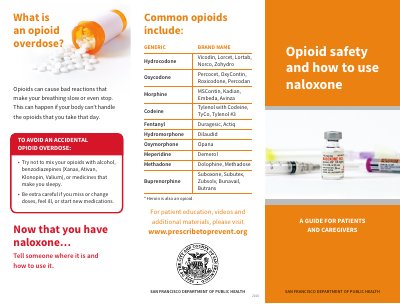
Opioid Safety and How to Use Naloxone Guide
This guide, published by the San Francisco Department of Public Health, explains the dangers of opioid overdose and lists common opioids that may cause it. It advises patients to avoid mixing opioids with alcohol, benzodiazepines, or other sedatives and to be cautious when changing doses or starting new medications.
The document provides detailed instructions on how to use four common types of naloxone products: nasal spray (with and without assembly), auto-injector, and injectable naloxone. It outlines the steps for checking responsiveness, calling 911, administering the medication, and performing rescue breathing or chest compressions until help arrives.
Covers: What is an opioid overdose · Common opioids · How to give naloxone · Nasal spray instructions · Auto-injector instructions · Injectable naloxone instructions
Latest San Francisco Department of Public Health manuals
Opioid Safety and How to Use Naloxone Guide
User Manual 2 pages · 398 KB · ENA guide for patients and caregivers on opioid safety, recognizing overdose symptoms, and administering naloxone via nasal spray, auto-injector, or injection.
Which document do I need?
User Manual
Day-to-day operation, settings and troubleshooting. Start here if the product is already set up.
Questions answered in San Francisco Department of Public Health manuals
What are the signs of an opioid overdose?
Signs include no response to shaking or speaking, slowed or stopped breathing, and lips or fingernails turning blue or gray.
How many doses of naloxone should be given if there is no reaction?
If there is no reaction in 3 minutes, a second dose of naloxone should be given.