
Key facts
- Manuals
- 6
- Languages
- EN
- Last added
- 2023-10-26
Featured U.S. Environmental Protection Agency manuals
U.S. Environmental Protection Agency AERMOD Implementation Guide
This document provides recommended practices for using AERMOD, a regulatory air dispersion model, in environmental assessments. It covers meteorological data processing, terrain modeling, urban applications, and source characterization. The guide is intended to support consistent, technically sound use of AERMOD and complements but does not replace the Guideline on Air Quality Models. It includes updates to reflect changes in AERMOD versions and modeling protocols.
The guide is structured by topic, with sections updated as of specific dates (e.g., 01/09/2008, 04/22/2021, 05/12/2023). It addresses issues such as surface roughness, albedo, Bowen ratio, terrain-following plumes, and urban roughness options. Users are advised to coordinate with reviewing authorities and develop modeling protocols before use.
Covers: What’s new in this document? · Document background and purpose · Meteorological data and processing · Terrain data and processing · Urban applications · Source characterization
U.S. Environmental Protection Agency Radon Guide for Tenants
This guide explains radon basics, how to test for it, and what tenants can do if high levels are found. It covers tenant responsibilities, building owner obligations, and available funding for radon reduction in rental housing. The guide is published by the U.S. Environmental Protection Agency and the Environmental Law Institute.
Tenants can test for radon themselves using kits available at hardware stores or by calling the National Radon Hotline. If levels are 4 pCi/L or higher, tenants should inform the building owner and request follow-up testing. Legal and community resources are available to assist with radon problems.
Covers: Purpose Of This Guide · What Is Radon? · Does Your Home Have High Radon Levels? · Can You Test For Radon Yourself? · What Can You Do If Your Home Has High Radon Levels? · What Can Building Owners Do About Radon Problems?
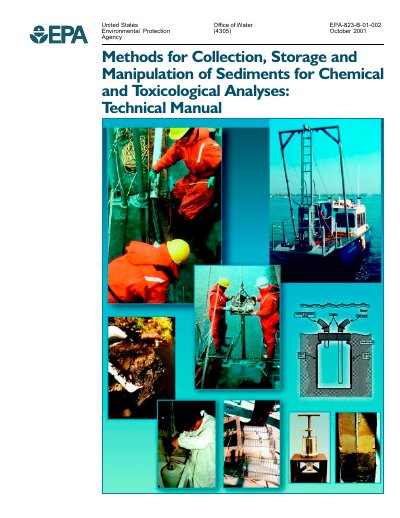
USEPA Methods for Collection, Storage and Manipulation of Sediments for Chemical and Toxicological Analyses
This technical manual provides standardized methods for collecting, handling, and manipulating sediment samples to ensure accurate and representative data for chemical and toxicological analyses. It compiles best practices from multiple monitoring programs and research institutions, including ASTM, Environment Canada, and the U.S. Army Corps of Engineers. The manual is intended for use by environmental agencies, researchers, and consultants to support sediment quality assessments and regulatory decision-making.
The document includes detailed procedures, equipment recommendations, and quality assurance protocols, with an emphasis on minimizing contamination and preserving sample integrity. It also provides an acronym list and references to supporting publications and standards.
Covers: Collection Methods · Storage Procedures · Manipulation Techniques · Quality Assurance · Acronym List · References and Supporting Publications
EPA-400/R-17/001 Protective Action Guides and Planning Guidance for Radiological Incidents
This document serves as a comprehensive guide for managing radiological incidents, issued by the U.S. Environmental Protection Agency (EPA) in January 2017. It supersedes previous manuals from 1992, 2013, and 2016, offering updated recommendations for protective actions and planning strategies. The guidance is designed to assist federal, state, tribal, and local agencies in responding to radiological emergencies without imposing legally binding requirements.
Covers: Overview · Early Phase Protective Action Guides · Emergency Worker Protection · Intermediate Phase Protective Action Guides · Planning Guidance for the Late Phase · Disposal of Large Volumes of Radioactive Waste
Latest U.S. Environmental Protection Agency manuals
U.S. Environmental Protection Agency AERMOD Implementation Guide
User Manual 36 pages · 452 KB · ENOfficial EPA guide for implementing AERMOD dispersion modeling in regulatory applications.
U.S. Environmental Protection Agency Radon Guide for Tenants
User Manual 10 pages · 51 KB · ENA guide for tenants on radon testing, health risks, and actions to take if high radon levels are detected in rental homes.
USEPA Methods for Collection, Storage and Manipulation of Sediments for Chemical and Toxicological Analyses
User Manual 208 pages · 5.3 MB · ENTechnical manual from the U.S. EPA for collecting, storing, and manipulating sediment samples for chemical and toxicological analyses.
EPA-400/R-17/001 Protective Action Guides and Planning Guidance for Radiological Incidents
Other 112 pages · 1.4 MB · ENThis manual provides protective action guides and planning guidance for radiological incidents, covering early, intermediate, and late phases of response.
TSCA New and Existing Chemicals Inspection Manual
Other 161 pages · 1.9 MB · ENAn inspection support tool providing guidance for EPA-credentialed inspectors conducting federal inspections under the Toxic Substances Control Act.
Tools of the Trade: A Guide To Designing and Operating a Cap and Trade Program For Pollution Control
Other 76 pages · 1.1 MB · ENA guide by the U.S. EPA on designing and operating cap and trade programs for pollution control, covering principles, implementation, and assessment.
Which document do I need?
User Manual
Day-to-day operation, settings and troubleshooting. Start here if the product is already set up.
Questions answered in U.S. Environmental Protection Agency manuals
What is the purpose of this guide?
This document provides information on the recommended use of AERMOD to address specific issues and concerns related to its implementation for regulatory applications.
From: U.S. Environmental Protection Agency AERMOD Implementation Guide
Is this guide a replacement for the Guideline on Air Quality Models?
No, this document is not intended as a replacement of, or even a supplement to, the Guideline on Air Quality Models (Guideline).
From: U.S. Environmental Protection Agency AERMOD Implementation Guide
What is radon?
Radon is a radioactive gas found in soil and rock in all parts of the United States. It is formed by the decay of uranium and is invisible, odorless, and tasteless.
From: U.S. Environmental Protection Agency Radon Guide for Tenants
What is the action level for radon?
The EPA recommends taking action to reduce radon if the level in your home is 4 pCi/L or higher.
From: U.S. Environmental Protection Agency Radon Guide for Tenants
What is the purpose of this technical manual?
This manual provides methods for collecting, handling, and manipulating sediment samples to yield accurate, representative sediment quality data for physicochemical characterization and biological testing.
Does this manual impose legally binding requirements?
No, the manual has no immediate or direct regulatory consequence and does not impose legally binding requirements on EPA, States, Tribes, or other regulatory authorities.