
Key facts
- Manuals
- 1
- Languages
- ZH
- Last added
- 2026-10-16
Featured Enriching Biotechnology manuals
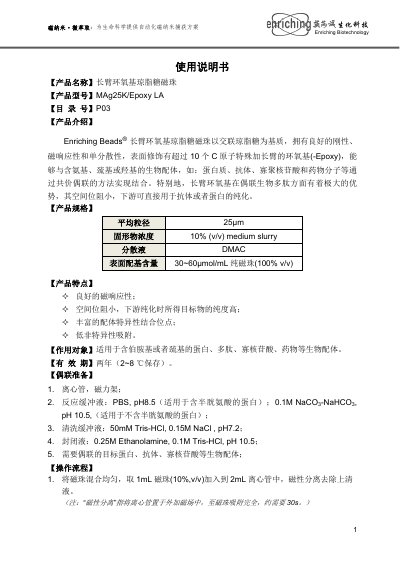
Enriching Biotechnology MAg25K/Epoxy LA Epoxy Agarose Magnetic Beads User Manual
This manual provides instructions for the Enriching Biotechnology MAg25K/Epoxy LA epoxy agarose magnetic beads. The product features a cross-linked agarose matrix with a long-arm epoxy surface modification, designed for the covalent coupling of ligands containing amino, thiol, or hydroxyl groups, such as proteins, antibodies, and oligonucleotides. It is specifically noted for its low steric hindrance, making it advantageous for downstream purification of antibodies and proteins. This manual is written in Chinese.
Covers: Product Introduction · Product Specifications · Coupling Preparation · Operation Process · Precautions · Compatible Equipment
Latest Enriching Biotechnology manuals
Enriching Biotechnology MAg25K/Epoxy LA Epoxy Agarose Magnetic Beads User Manual
User Manual 3 pages · 414 KB · ZHUser manual for Enriching Biotechnology MAg25K/Epoxy LA epoxy agarose magnetic beads, detailing coupling protocols and storage.
Which document do I need?
User Manual
Day-to-day operation, settings and troubleshooting. Start here if the product is already set up.
Questions answered in Enriching Biotechnology manuals
What types of ligands can be coupled to these magnetic beads?
The beads can be coupled with ligands containing amino, thiol, or hydroxyl groups, such as proteins, antibodies, oligonucleotides, and drug molecules.
From: Enriching Biotechnology MAg25K/Epoxy LA Epoxy Agarose Magnetic Beads User Manual
What is the recommended reaction temperature for coupling antibodies or proteins?
The recommended reaction is at room temperature for 12-16 hours, or at 37°C for 12 hours for better results.
From: Enriching Biotechnology MAg25K/Epoxy LA Epoxy Agarose Magnetic Beads User Manual