
Key facts
- Manuals
- 1
- Languages
- ES
- Last added
- 2023-11-29
Featured IFC manuals
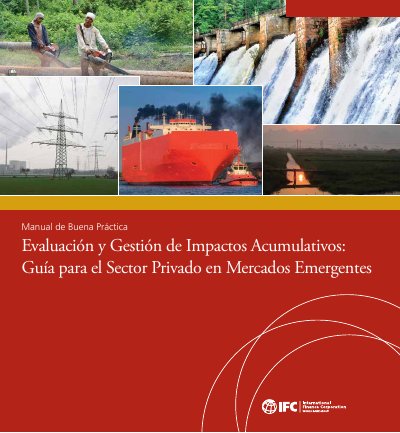
IFC Cumulative Impact Assessment and Management Good Practice Manual for Private Sector in Emerging Markets
This IFC good practice manual addresses cumulative impact assessment and management (EGIA) for private-sector projects in emerging markets. It explains what cumulative impacts and EGIA are, when an EGIA is needed, and how the process relates to environmental and social impact assessment.
The manual sets out a six-step EGIA process, from preliminary assessment and spatial and temporal boundaries through baseline conditions, impact evaluation and management. It also discusses implementation challenges, roles and responsibilities, government engagement, conclusions, and appendices with indicators and terms of reference. This manual is written in Spanish.
Covers: ¿Qué son los impactos acumulativos? · ¿Qué es la evaluación y gestión de impactos acumulativos (EGIA)? · Proceso de seis pasos para implementar una EGIA · Evaluación preliminar: VEC, límites espaciales y temporales · Línea base de los componentes ambientales y sociales valorados (VEC) · Evaluación y significancia de impactos acumulativos
Latest IFC manuals
IFC Cumulative Impact Assessment and Management Good Practice Manual for Private Sector in Emerging Markets
Other 102 pages · 1.1 MB · ESIFC good practice manual on cumulative impact assessment and management for private-sector projects in emerging markets.
Questions answered in IFC manuals
What does EGIA stand for in the manual?
It stands for Evaluación y Gestión de Impactos Acumulativos, the Spanish term used for cumulative impact assessment and management.
Who prepared this good practice manual?
It was prepared jointly by IFC's Environment, Social Development and Governance Department and ESSA Technologies Ltd. of Vancouver, Canada.