
Key facts
- Manuals
- 3
- Languages
- EN
- Last added
- 2026-10-26
Featured ASC manuals
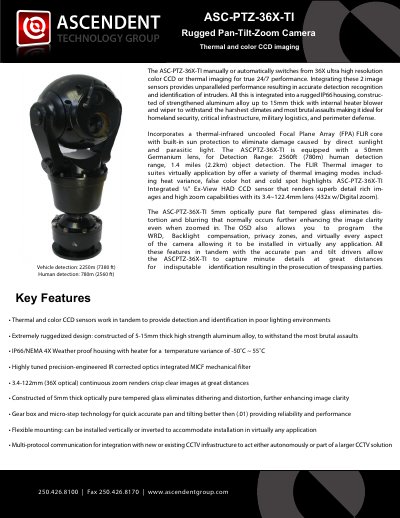
ASC ASC-PTZ-36X-TI Rugged Pan-Tilt-Zoom Camera Product Leaflet
The ASC-PTZ-36X-TI is a rugged pan-tilt-zoom camera designed for 24/7 performance in harsh climates. It integrates thermal and color CCD imaging to provide accurate detection and identification of intruders, making it ideal for homeland security, critical infrastructure, and perimeter defense. The unit is constructed of strengthened aluminum alloy with an internal heater and wiper to withstand temperatures from -50°C to 55°C.
Covers: Key Features · Performance Parameters · 36x Optical Zoom Module · Thermal Imager · Mechanical Drive Unit · Physical Construction
ASC Logo User Guide 2019
This document serves as a user guide for the Aquaculture Stewardship Council (ASC) logo, detailing the rules for its use on packaging, restaurant menus, fish counters, and promotional materials. It explains that only organizations eligible to sign a license agreement with ASCI may use the logo, and unauthorized display is prohibited.
The guide provides specific instructions on the three ASC elements (logo, claim, and Chain of Custody code), available formats and colors, minimum size requirements, and clear space rules. It also lists incorrect usage examples to avoid, such as distorting the shape, changing colors, or placing items over the logo.
Covers: Protecting the ASC's trademarks · Three easy steps to successfully using the ASC logo · The three ASC elements · Formats and colour · Size and clear space · Incorrect logo usage
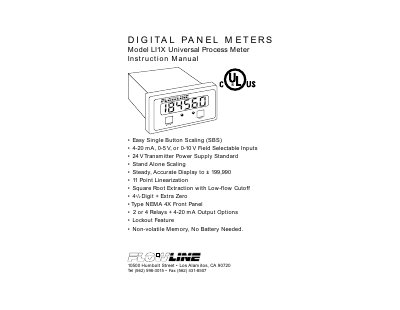
ASC LI1X Universal Process Meter Instruction Manual
The ASC LI1X Universal Process Meter is a high-performance, microprocessor-based digital meter designed for industrial applications. It accepts standard process signals including 4-20 mA, 0-5 V, 1-5 V, and 0-10 V, displaying them on a 4 1/2 digit LED display with an extra zero. The device features a 24 VDC transmitter power supply and supports options such as 2 or 4 relays and an isolated 4-20 mA output.
Covers: Typical Applications · Ordering Information · Safety Notice · Specifications · Wiring Instructions · Programming
Latest ASC manuals
ASC ASC-PTZ-36X-TI Rugged Pan-Tilt-Zoom Camera Product Leaflet
Product Leaflet 2 pages · 260 KB · ENProduct leaflet for the ASC ASC-PTZ-36X-TI rugged PTZ camera featuring 36x optical zoom, thermal imaging, and an IP66/NEMA 4X housing for harsh environments.
ASC Logo User Guide 2019
Other 19 pages · 1.7 MB · ENThis guide outlines rules for using the ASC logo on packaging, menus, and promotional materials, including formats, colors, and usage restrictions.
ASC LI1X Universal Process Meter Instruction Manual
User Manual 19 pages · 126 KB · ENInstruction manual for the ASC LI1X Universal Process Meter, covering installation, programming, calibration, and alarm configuration for industrial process…
Which document do I need?
User Manual
Day-to-day operation, settings and troubleshooting. Start here if the product is already set up.
Questions answered in ASC manuals
What is the detection range for vehicles and humans?
The camera detects vehicles up to 2250m (7380 ft) and humans up to 780m (2560 ft).
From: ASC ASC-PTZ-36X-TI Rugged Pan-Tilt-Zoom Camera Product Leaflet
Is the camera suitable for extreme weather conditions?
Yes, it has an IP66/NEMA 4X housing with a heater and wiper to operate from -50°C to 55°C.
From: ASC ASC-PTZ-36X-TI Rugged Pan-Tilt-Zoom Camera Product Leaflet
Who acts as the agent for licensing and administration of the ASC logo?
The Marine Stewardship Council International (MSC) Licensing Team acts as the ASC's agent regarding licensing and administration.
From: ASC Logo User Guide 2019
What are the three easy steps to using the ASC logo?
The steps are: 1. Add the ASC logo to your materials, 2. Submit your artwork for approval, and 3. Get approval from the Licensing Team.
From: ASC Logo User Guide 2019
Does the LI1X require a battery for memory?
No, the meter uses non-volatile memory and does not require a battery to store programming values.
What is the minimum difference required between Input 1 and Input 2 for calibration?
The minimum difference depends on the input range: 0.16V for 0-5V, 0.32V for 0-10V, and 1.60 mA for 4-20 mA.