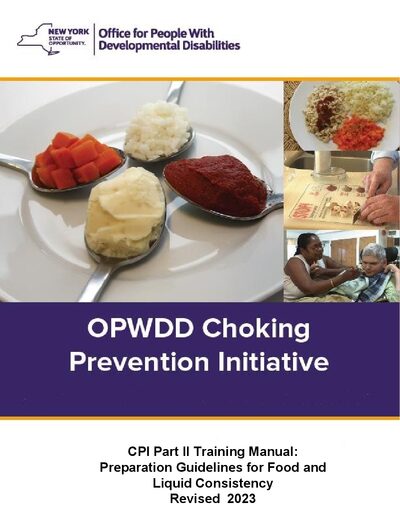
New York State Office for People With Developmental Disabilities (OPWDD) Food and Liquid Consistency Preparation Guidelines
About this manual
This manual, prepared by the New York State Office for People With Developmental Disabilities, defines food and liquid consistency categories and provides preparation instructions to reduce choking and aspiration risk. It emphasizes maintaining appearance, flavor, and moisture while following clinician‑prescribed diet orders.
The document includes terminology, high‑risk food lists, and practical tips such as using broth or low‑fat sauces to moisten overcooked meats, and the requirement for gloves in certain settings. References to national dysphagia standards are discussed, with OPWDD choosing its own terminology.
What's inside
- Introduction
- Terms and Definitions
- Whole Diet
- Pieces Cut to Size
- Ground
- Pureed
- Liquidized
- Soft and Hard
- High Risk Foods
- References
Frequently asked questions
Which foods are identified as high‑risk for choking?
High‑risk foods include apple chunks and slices, bacon, bread, cheese (cubed, string or melted), chewing gum, coconut, corn, crackers, croutons, donuts, dried fruits, and many others.
What personal protective equipment is required when preparing foods in ICF settings?
Gloves are required in ICF settings to prevent bare‑hand contact with foods that will not be cooked to a required temperature.