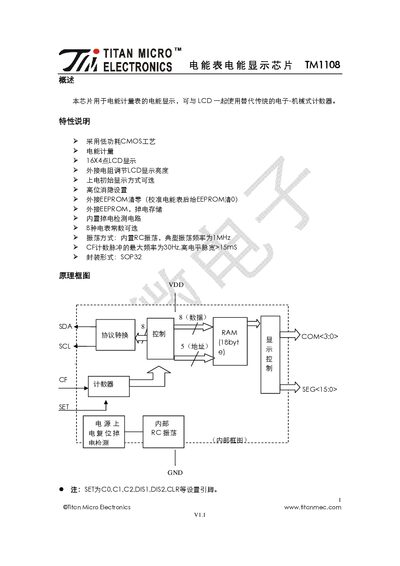
The Titan TM1108 datasheet details features, pinout, settings, application circuits, and electrical specifications for the energy‑meter display chip.
About this manual
The TM1108 is a low‑power CMOS chip designed for energy‑meter displays, driving a 16×4 LCD and supporting external EEPROM for calibration and data retention. It offers selectable meter constants, brightness control via an external resistor, and various power‑on display options.
The document provides pin descriptions, configuration settings, typical application circuits with EEPROM and LCD, and extensive electrical, switching, and timing parameters. It also lists package information and revision history. This manual is written in Chinese.
What's inside
- Overview
- Features
- Pin Arrangement and Description
- Setting Description
- Application Circuit
- Electrical Parameters
- Switch Characteristics
- Timing Characteristics
- Package
- Revision History
Specifications
| Logic supply voltage (VDD) range | -0.5 to +6.0 V |
|---|
| Logic input voltage (VI1) range | -0.5 to VDD+0.5 V |
|---|
| Operating temperature range | -40 to +105 °C |
|---|
| Storage temperature range | -65 to +150 °C |
|---|
| Typical supply current (IDD) | 10 µA |
|---|
| High‑level output voltage (VIH) | 0.65 × VDD |
|---|
| Oscillator frequency (Fosc) | 1 MHz |
|---|
Frequently asked questions
How is LCD brightness adjusted?
Brightness is set by connecting a pull‑up resistor to the VLCD pin; the pin includes an internal 60 kΩ pull‑down.
How can the display be cleared to zero?
Pull the CLR pin low (connect to GND) for a few tens of microseconds; the chip will reset all data to zero.
How many meter constants can be selected?
Eight different meter constants are selectable via the C0, C1, and C2 pins.